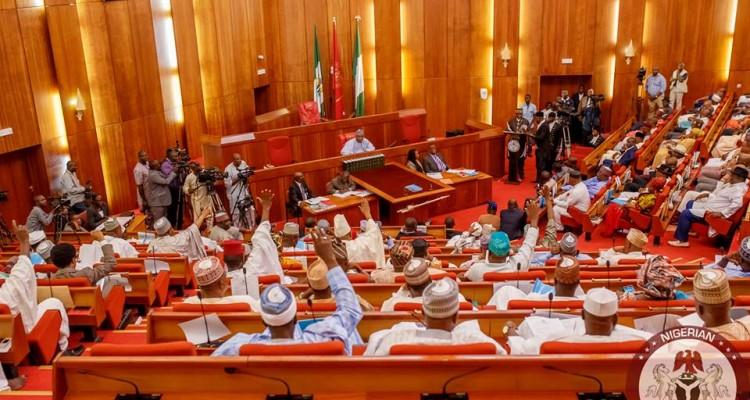
The House of Representatives has mandated its Committee on Banking and Currency to carry out full investigation into the activities of the Development Finance Department of the Central Bank of Nigeria (CBN), the Nigeria Incentive-Based Risk Sharing System for Agricultural Lending (NIRSAL) and any other such schemes under the Department.
The Green Chamber took the decision Tuesday at plenary sequel to the adoption of a motion on: “Need to Investigate the Activities of the Development Finance Department of the Central Bank of Nigeria and the Nigeria Incentive–Based Risk Sharing System for Agricultural Lending (NIRSAL) sponsored by Jaha Usman (APC, Borno).
Presenting the motion, Jaha said several schemes and initiatives being managed by the Development Finance Department like NIRSAL designed to provide farmers with affordable financial products and reduce the risk of financial institutions that grant them loans; the Anchor Borrowers’ Programme (ABP), the Commercial Agriculture Credit Scheme (CACS) and the N235 Billion SME Credit Guarantee Scheme (SMECGS) are replete with irregularities and not at optimal performance.
He expressed concern that the N200 billion SME Restructuring/Refinancing Fund (RRF) was suddenly discontinued by the Management of the bank without any explanation to relevant government agencies and key stakeholders.

The lawmaker is also concerned that the N300 billion Real Sector Support Facility (RSSF) established in 2014 to address the funding needs of large ticket SMEs in Nigeria to closing the short-term and high- interest financing gap for SME/Manufacturing and start-ups as well as create jobs through the Real Sector of the Nigerian economy has remained a dormant initiative.
Jaha said the was: “Disturbed that the CBN, in 2015 established the Nigeria Electricity Market Stabilisation Facility (NEMSF) and invested N213billion in a Refinancer – NESI Stabilization Strategy Ltd to provide refinance for the NEMSF aimed at putting the Nigerian Electricity Supply Industry (NESI) on a route to economic viability and sustainability by facilitating the settlement of Legacy Gas Debts and payment of outstanding obligations due to Market Participants, Service Providers and gas suppliers that accrued during the Interim Rules Period (IRP Debts) but the impact of such an investment is not yet being felt in the economy.
“Worried by the recent outcry by over 800,000 applicants that the N50 billion Targeted Credit Facility (TCF) stimulus package announced by the Central Bank of Nigeria (CBN) in March 2020 to help mitigate the impact of the coronavirus pandemic on the economy and businesses, and to support households and micro, small and medium enterprises (MSMEs) that have been affected by the COVID-19 pandemic which was to be disbursed through the NIRSAL Microfinance Bank Ltd (NMBL) is not easily accessible due to difficult conditionalities attached to the facility;
Also worried that the Management of NIRSAL Microfinance Bank Ltd (NMBL) is reported to have allegedly diverted over 1 billion naira into a personal account of one of its management staff.
“Conscious of the provisions of section 88 (1) of the Constitution to the effect that the National Assembly shall have power by resolution to direct or cause to be directed investigation into any matter or thing with respect to which it has power to make laws, and the conduct of affairs of any person, authority, ministry or government department charged, or intended to be charged with the duty of or responsibility for executing or administering laws enacted by the National Assembly”.
The House:
Notes that Section 4 (2) of the Constitution of the Federal Republic of Nigeria, 1999 (as amended) provides that the National Assembly shall have power to make laws for the peace, order and good government of the Federation or any part thereof with respect to any matter included in the Exclusive Legislative List set out in part of the second schedule to this Constitution;
Also Notes the provisions of Chapter II of the 1999, Constitution on the Fundamental Objectives and Directive Principles of State Policy in Section 13 which provides that it shall be the duty and responsibility of all organs of government, and of all authorities and persons exercising legislative, executive or judicial powers to conform, observe and apply the provisions of the Constitution;

Further notes the combined effect of Section 16 (1) (a) and (b) which provides that the state shall harness the resources of the nation and promote national prosperity and an efficient, a dynamic and self–reliant economy and control the national economy in such a manner as to secure the maximum welfare, freedom and happiness of every citizen on the basis of social justice, equality of status and opportunity;
Aware of the functional role of the Central Bank of Nigeria (CBN) to promote monetary stability, ensure sound financial environment and act as financial adviser to the federal government;
Also aware that development financing is key to sustainable economic growth in any economy as it ensures the supply of finance to various sectors of the economy to promote economic growth, development and welfare improvement at a faster rate;
Further aware that the Development Finance Department of the CBN is responsible for the formulation and implementation of various policies, innovations of appropriate products and creation of enabling environment for financial institutions to deliver services in an effective, efficient and sustainable manner, mainly targeted at the agricultural sector, rural development and micro, small and medium enterprises;
Informed that the Development Finance Department of the CBN, in line with its mandate to ensure real sector growth, financial inclusion and entrepreneurship development formulates and manages several schemes and initiatives including the Nigeria Incentive-Based Risk Sharing System for Agricultural Lending (NIRSAL), Anchor Borrowers’ Programme (ABP), Commercial Agriculture Credit Scheme (CACS), Agricultural Credit Guarantee Scheme Fund (ACGSF), Agricultural Credit Support Scheme (ACSS), Interest Drawback Programme (IDP), Microfinance Policy, Financial Inclusion, Entrepreneurship Development Activities, Power and Airline Intervention Fund (PAIF), Small and Medium Enterprises Credit Guarantee Scheme (SMECGS), SME Restructuring/Refinancing Fund (RRF), Real Sector Support Facility (RSSF), National Collateral Registry (NCR) and Nigeria Electricity Market Stabilization Facility (NEMSF);