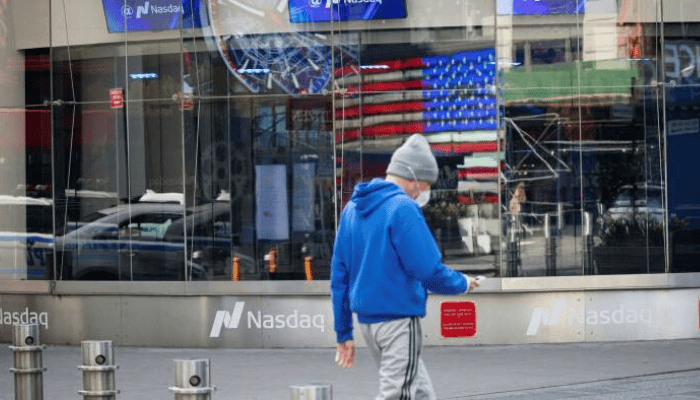
US stocks were mixed on Monday, as tensions flared between the US and China over the origin of the coronavirus pandemic.
The S&P 500 saw its third straight day of losses, slipping 0.3 per cent in afternoon trading. The tech-heavy Nasdaq Composite fared better, rising 0.6 per cent.
The moves came after Mike Pompeo, US secretary of state, on Sunday reiterated US government claims linking the coronavirus outbreak to a laboratory in Wuhan, China, without providing any evidence. China has denied the virus came from the lab.
In a television interview, Mr Pompeo said China was also blocking access to information and refusing to co-operate with overseas scientists trying to develop a vaccine.
In Europe, the benchmark Stoxx 600, which tracks the region’s largest companies, closed lower by 2.7 per cent. The losses were sharpest in continental Europe, where markets had missed out on Friday’s sell-off because of a public holiday. In Frankfurt, the Dax fell 3.6 per cent, while the CAC 40 in Paris was 4.4 per cent lower. London’s FTSE 100, which had fallen more than 2 per cent in the previous session, slipped a further 0.2 per cent.

Analysts said an upcoming decision in the German constitutional court on the legality of the European Central Bank’s asset-purchasing programme was also weighing on market sentiment in Europe because it could undermine the central bank’s Covid-19 response.
Renewed tensions between the US and China have come at a delicate moment for markets, which climbed in April even with much of the global economy in freefall after widespread lockdowns to stop the spread of coronavirus.
“The last thing we need is more trade war,” said Kit Juckes, a strategist at Société Générale.
On Friday, the S&P 500 shed 2.8 per cent after US president Donald Trump threatened to use tariffs against Beijing, escalating his attack on China over the origins of the public health crisis.
Strategists at Bank of America said their discussions with clients had revealed “a fairly unanimous view that the US-China relationship would worsen moving ahead”.
The Wall Street bank said the biggest risk was the sustainability of the “phase one” trade deal signed in January after months of negotiations.

“It is possible that the US administration feels emboldened to restart the trade rhetoric given the rally stocks have undergone in recent weeks,” said Robert Carnell, ING’s head of Asia-Pacific research. “If so, Friday’s S&P 500 sell-off comes as a reminder that the underlying drivers for markets have not changed.”
The re-emergence of US-China trade tensions also weighed on the price of industrial metals. Copper extended its decline from its late-April high of $5,250 a tonne, trading as low at $5,060 on Monday.
Aluminium dropped 0.7 per cent to $1,487.
Weak manufacturing data and the absence of Chinese buyers because of a public holiday added further pressure on the sector.
“As the global economy looks to escape its current lockdown, May is likely to be a test month and for that reason risk appetite is likely to remain muted at best,” said Alastair Munro, a metals trader at brokerage Marex Spectron.
Asian stocks also dropped on Monday. Hong Kong’s benchmark Hang Seng fell 4.2 per cent, while South Korea’s Kospi slid 2.9 per cent. Markets in Japan and mainland China were shut for holidays.
Oil benchmarks also got off to a poor start for the week, hit by persistent worries about oversupply and inadequate storage. West Texas Intermediate, the US marker, was down 0.5 per cent at $19.76 a barrel while Brent crude, the international benchmark, dropped 0.2 per cent to $26.38.
The decline in oil prices, which followed their first weekly gain in a month, came as optimism over output cuts began to sour again.
Last month, US oil prices collapsed into negative territory for the first time as the rising cost of increasingly scarce storage pushed producers to pay buyers to take the product off their hands.
Signs of risk aversion were still prevalent on Monday, with a $500m oil exchange-traded fund in Hong Kong saying that its broker had blocked it from increasing its holdings of crude oil futures.
Analysts at Citi warned that the “worst is likely yet to come, given signs of global storage reaching tank tops even as a demand recovery starts”.