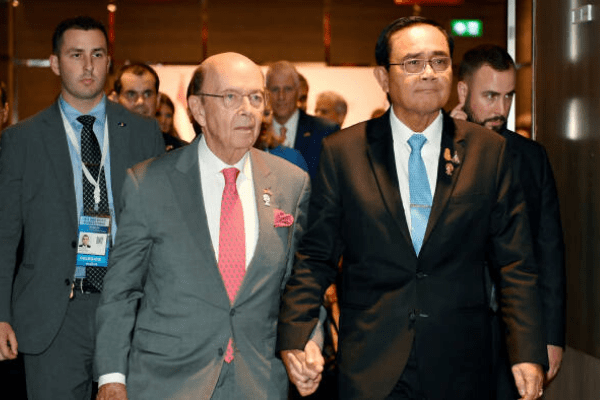
Wilbur Ross, the US commerce secretary, said on Sunday that he was “quite optimistic” that remaining sticking points in the first phase of American trade talks with China could be resolved soon, adding that the countries’ leaders still planned to meet later this month.
US President Donald Trump and Chinese leader Xi Jinping were on track to meet in November, Mr Ross said, although the venue was a “work in progress”, following last week’s scrapping of the planned APEC summit in Santiago during Chile’s recent unrest.
“You won’t have a deal on anything until you have a deal on everything,” Mr Ross told the Financial Times in Bangkok, where he is part of a large delegation of US officials attending a summit of Asean, the regional grouping, and associated meetings with Asian and Pacific leaders. “But we are quite optimistic that the remaining issues for the phase one can be closed out.”
Mr Ross said that Alaska and Iowa — the latter mentioned by Mr Trump on Friday in a tweet — were potential alternative venues for the talks, and that “some [countries] in Asia as well” might host them.

For Asian countries, the focus is on progress over the Regional Comprehensive Economic Partnership, a proposed mega-trading bloc comprising the 10 Asean nations that would also include China, India, Japan, South Korea, Australia and New Zealand that has been under negotiation since 2012.
Hopes that a final deal on RCEP would be reached at the Asean summit receded at the weekend as leaders of the 16 nations argued over last-minute details of the proposed agreement. India, which is wary of the repercussions of opening its market to Chinese goods, is among the countries pushing for concessions.
Mr Ross said that the US, which has voiced scepticism about RCEP, thought there were “quite enough regional associations”.
However, he denied Washington would reward countries that refrained from joining or punish members of the new grouping. “We treat countries favourably even if they have trade pacts with other nations,” he said.
On Monday the Americans will host an “Indo-Pacific Business Forum” in Bangkok, in which Washington will seek to present itself as an alternative business partner for countries living in China’s shadow that have questioned the financial, environmental and other costs of Beijing-backed projects. The US commerce secretary will travel to Indonesia and Vietnam later in the week.

Mr Ross, along with Robert O’Brien, the national security adviser, are leading the US delegation to the Asean summit, which officials previously had said Mr Trump or Mike Pence, vice-president, might join.
“This is a major effort on the part of the US government,” he said, rejecting some regional analysts’ view that American economic power is being eclipsed by China’s, and adding that 24 senior government officials were in Bangkok, including 15 US ambassadors and chiefs of mission.