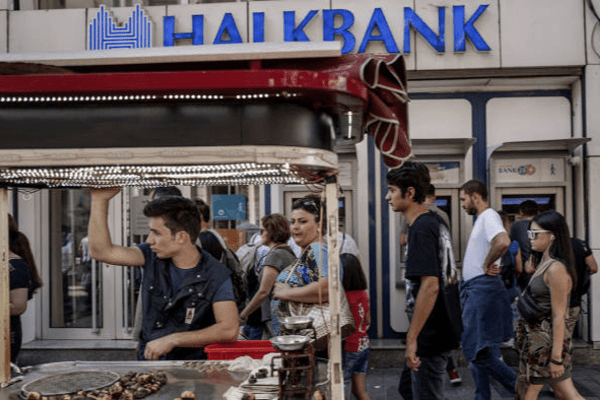
One of Turkey’s largest banks has been hit with charges of fraud and money laundering by US prosecutors in connection with a multibillion-dollar sanction-busting scheme.
In a move likely to sharply escalate growing tensions between Ankara and Washington on the eve of a visit by Mike Pence, the US vice president, to Turkey, New York prosecutors filed an indictment against Halkbank accusing it of violating US sanctions on Iran.
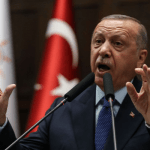
The charges against the state-owned lender are the culmination of a long-running investigation into an elaborate gold-for-oil scheme that was allegedly carried out with the help of several former ministers in the government of Recep Tayyip Erdogan, the Turkish president. Mr Erdogan has previously described a related inquiry into one of the bank’s senior executives as a grand conspiracy that amounted to an “international coup attempt”.
Although it is rare for the US Department of Justice to intervene in investigations, the timing of the charges is likely to be viewed with deep suspicion among the Turkish leadership, coming as Washington seeks to turn the screws on Ankara over its military incursion into Syria.

The Southern District of New York, which led the investigation, is renowned for its independence. But Jonathan Schanzer, a former US Treasury official who followed the case closely, described the prosecution as “just one of the measures” that was being deployed by Donald Trump while “scrambling to deter Turkey” from its Syrian operation.
He said that Halkbank had refused to negotiate a fine, believing it “could outlast the Department of Justice through prolonged obstinacy”. Mr Schanzer said the strategy “began to unravel” as friction mounted between the US president and Mr Erdogan over the Turkish incursion.
Announcing the charges, US Attorney Geoffrey Berman described Halkbank’s conduct as “audacious”, adding that it had been “supported and protected by high-ranking Turkish government officials, some of whom received millions of dollars in bribes”. He added: “Halkbank will now have to answer for its conduct in an American court.”
Prosecutors allege that proceeds from the sale of Iranian oil and gas to Turkey were deposited at Halkbank, which then used various sanctions-busting schemes to make some $20bn of the funds available to the government of Iran, including facilitating sham purchases of food and medicine by Iranian customers.
Halkbank has in the past denied violating US sanctions. Halkbank said in a statement that the charges were filed as part of the Trump administration’s sanctions imposed this week on Turkey in response to Ankara’s military offensive against the Kurdish forces. The US on Monday announced sanctions on several Turkish ministers and departments, and raised tariffs on the country’s steel exports.

Following the news of the prosecution, the Istanbul stock exchange announced it had “temporarily prohibited” short selling in the shares of seven banks, including Halkbank — which is part publicly traded — and several of the country’s biggest private lenders. It did not say how long the ban would last.
The decision to prosecute the lender came just hours before Mr Pence was due to arrive in Ankara with a delegation of senior officials to discuss Turkey’s contentious military offensive against Kurdish militias in north-east Syria.
The assault, which began last week after Mr Trump seemingly gave the green light by pulling American troops out of harm’s way, has been met with an international backlash and forced the US president on to the defensive.
While Turkey views the Kurdish forces it is targeting as terrorists, they have received weapons and training from the US and spearheaded a campaign against Isis jihadis in the region.
Mr Trump, who had threatened to “obliterate” Turkey’s economy if its operation went “off limits”, on Monday imposed US sanctions on the country. The measures were greeted with relief by foreign investors, who had feared much harsher steps. The news of a Halkbank prosecution risks reigniting volatility in the Turkish financial markets.
The case has been followed closely by Mr Erdogan, who found several of his senior ministers entangled in the gold-for-oil scheme when the accusations first became public in 2013.
At its centre was Reza Zarrab, a Turkish-Iranian millionaire married to a Turkish pop star who frequently rubbed shoulders with Turkey’s political elite.
Mr Zarrab, 36, was arrested in March 2016 at Miami airport on his way to Disneyland with his family and charged with being the scheme’s mastermind. Mr Erdogan personally tried to secure his release, while Mr Zarrab enlisted the help of Rudy Giuliani, who later become the personal lawyer of the US president.
Although officials in the US administration have always insisted that the investigation is out of their hands, Bloomberg News agency reported last week that Mr Trump in 2017 pressed his then secretary of state Rex Tillerson to lean on the DOJ to drop the case against Mr Zarrab. Mr Tillerson refused, according to the report, and Mr Zarrab remained behind bars.
Later, the gold trader accepted a plea bargain and turned state witness. He played a key role in the conviction last year of Hakan Atilla, a former senior Halkbank executive, on six counts of bank fraud and conspiracy to evade US sanctions.
The prospect of a prosecution into the bank itself — or a US Treasury fine — has long hung over Halkbank.
Earlier this month the rating agency Fitch warned that a fine or other punitive measures imposed by US investigators could “materially weaken solvency, increase refinancing risks or negatively affect other aspects of the bank’s credit profile”.