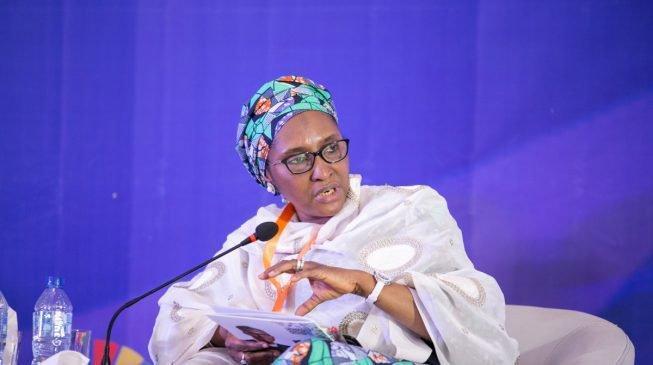
The Federal Government is under pressure to meet the revenue target of N8.155 trillion proposed in the 2020 budget, Zainab Ahmed, minister of finance, budget and national planning, said in Abuja on Monday.
Ahmed, who spoke at the breakdown of the 2020 executive budget proposal, admitted that government is under pressure to rev up revenues and ensure that revenue targets are met to fund development.
“Nigeria must mobilise significant resources to invest in human capital development and critical infrastructure,” Ahmed said. “Given the low revenue to GDP ratio (currently at about 7 percent), we must pursue optimal revenue generation.”
She called on Nigerians as well as prospective investors to support government in solving the country’s revenue generation problems.

She warned ahead that “some reforms will be tough but must be done if we will look at the facts and be frank to ourselves” and assured on engagements with the private sector on any changes in taxes with regard to rates or administration methods.
“Achieving fiscal sustainability and macro-fiscal objectives of government will require bold, decisive and urgent action. Government is determined to act as may be required,” she said.
Ahmed said the government has recently launched strategic revenue growth initiatives to boost revenue generation to drive the targeted revenue to GDP ratio of 15 percent as set out in the Economic Recovery and Growth Plan.
“We have launched the strategic revenue growth initiatives with three thematic areas, which include achieving sustainability in revenue generation, identifying new and enhanced enforcement of existing revenue streams, and achieving cohesion and elimination of identified leakages,” she said.
“There is need to build a sustainable revenue generation ecosystem by ensuring resilient and optimal performing revenue streams while applying the right incentives, safeguard, accountability and performance Management systems,” she further said.

“The 2020 budget is designed to be a budget of fiscal consolidation to strengthen our macroeconomic environment and investment in critical infrastructure, human capital development and enabling institutions key to job creation,” Ben Akabueze, director general, Budget Office, said.
He said more revenues are needed to drive the expenditure and ensure that the budget works for all citizens, explaining that the budget seeks to enhance the social investment programmes to deepen their impact on the marginalised and most vulnerable Nigerians.
Tunde Fowler, chairman, Federal Inland Revenue Service (FIRS), said the importance of the increase in value added tax (VAT) cannot be overemphasised as there is need to ensure increased revenue to fund the budget.
He, however, stressed that the increased VAT would raise the capacity of the state governments to meet the needs of the citizens since they receive over 80 percent of the VAT.
The House of Representatives Committee on Petroleum Resources (Upstream) has, meanwhile, urged the Nigeria National Petroleum Corporation (NNPC) to step up its operations in order to raise the revenue needed by the Federal Government to fund the 2020 budget.
Musa Adar, chairman of committee, made the call on Monday when Mele Kyari, NNPC GMD, appeared to interface with the lawmakers on the operations of the agency in the upstream petroleum sector.
Adar wondered why Nigeria always had a deficit budget with the quantum of petroleum it produces and called on the NNPC to generate more revenue for the country.
He noted that with the formal engagement with NNPC and other agencies, there was need to plug all the loopholes in the revenue profile of the agency for the benefit of Nigerians.
In his response, Kyari said NNPC was taking steps to realise the national target of 3 million bpd and 40 million barrels of reserve of oil before the end of 2023, lamenting that there were challenges in the oil sector which the present management of NNPC was poised to tackle.
He also appealed to the lawmakers to help put in place relevant legislations that would help in attracting foreign investment into the petroleum sector.
The key assumptions of the 2020 budget as proposed by the government has oil price at $60/b, inflation rate at 9.98 percent, GDP growth at 3.01 percent, exchange rate at N305/$, nominal consumption at N119.28 trillion, crude oil production at 2.3 million bpd, and nominal GDP at N139.65 trillion.
A breakdown of the budget shows a total of N8.15 trillion revenue, with N1.81 trillion projected to be derived from non-oil, N2.64 trillion from oil, and N3.7 trillion from other revenue sources.
The proposed total expenditure stands at N10.33 trillion. Expenditure by the ministries, departments and agencies is projected at N2.145 trillion, recurrent expenditure at N4.88 trillion, debt service at N2.453 trillion, sinking funds at N296 billion, statutory transfer at N556 billion, leaving a deficit of N2.18 trillion.
A further breakdown of the budget proposal shows that N259.2 billion has been allocated to Works and Housing, N127.67 billion allocated to Power, N123.07 billion allocated to Transport, N162.74 billion allocated to Education, and N99.87 billion allocated to Defence.
Others include N90.98 billion for Health, N79.79 billion for Agriculture and Rural Development, N45.45 billion for Ministry of Humanitarian Affairs, Disaster Management and Social Development, N53.85 billion for Aviation, N78.34 billion for Ministry of Water Resources, N41.34 billion for Ministry of Industry, Trade and Investment, and N37.55 billion for Ministry of Science and Technology.
CYNTHIA EGBOBOH & JAMES KWEN, Abuja