
Dividend yield for Nigerian equities has risen on the back of low stock prices following the rout on Nigerian Stock Exchange (NSE) which has depressed most liquid and capitalized stocks.
The equity market maintained a bullish run Friday gaining a marginal 62 basis points, but a year-to-date loss of 12 percent makes the bourse one of the worst performers globally.
High yield signal good buy opportunity particularly for value investors who seek attractive returns on undervalued stocks.
Also known as dividend return per stock, it is the percentage value of a company’s dividend per share to its market price. Assuming dividend declared by a company’s board of directors remain unchanged yields jumps when stock prices declines and vice-versa.

However, it is unwise for investors to price in only yield when doing their stock valuation because yields tend to be ‘surprisingly high’ for illiquid stocks trading at low prices.
So investors that want to take position in high dividend stocks need to complement yield with the dividend track record of such company and other market indicators.
Nigerian stocks are trading seven times for each naira earnings compared to South Africa (15x), Egypt (12x) and emerging markets (11x), making them one of the cheapest in the emerging markets space.
BusinessDay computed and ranked dividend yields of the thirty most liquid and capitalized stocks on NSE which accounts for over 90 percent of the bourse’s market value. The rationale is that some of these stocks still have attractive valuation, and hold potentials to deliver returns to investors.
Data compiled from Bloomberg provided figures on dividend yields for 23 stocks except EcoBank, Union Bank, Sterling Bank, Lafarge Africa, Oando, International Breweries and Airtel Africa.

Taking the first spot is Total Nigeria Plc, the country’s fourth-largest listed oil firm by market value (N35.92bn), with 16.07 percent yield ahead Mobil (5.22%) and Seplat (3.68%).
However, weak investor sentiment on the back of tainted growth potentials of the broader economy coupled with unimpressive earnings performance tumbled Total’s share price to lowest in more than five years.
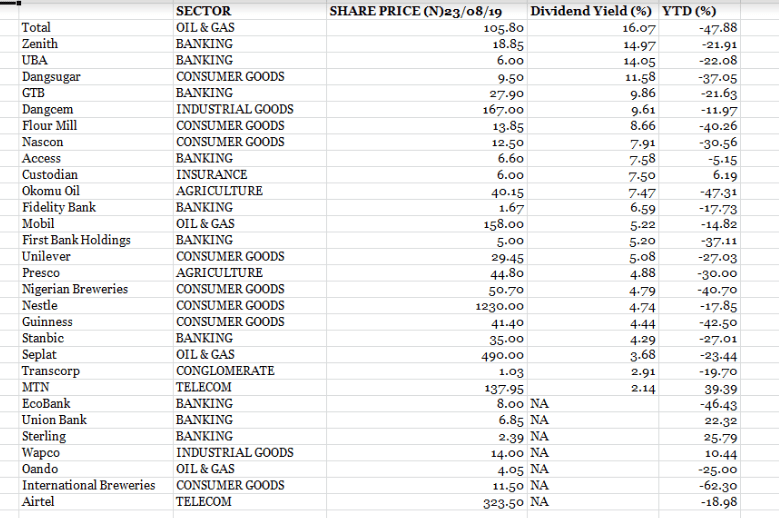
Total has plunged some 48 percent since January equivalent to a monetary loss of N33 billion. This compares with Mobil, Seplat and Oando that has slid 14 percent, 23 and 25 percent respectively in almost eight months.
Zenith Bank, Nigeria’s second most valuable lender, led other banks with 14.97 percent yield ahead UBA (14.05%), Guaranty Trust Bank (9.86%), Access (7.58%), Fidelity (6.59%), First Bank (5.2%) and Stanbic (4.29%).
Banking stocks have declined 5 percent since July 3 when Central Bank of Nigeria mandated banks to loan at least 60 percent of their deposits to small businesses in a bid to boost economic growth through credit creation.
Banks are keen to expand their retail footprints to bolster profitability amid weakening interest income.
Dangote Sugar Refinery led the pack of consumer goods firms with dividend yield of 11.58 percent while Nigeria’s miller by market value, Flour Mill of Nigeria took the second spot with a yield figure of 8.66 percent.
Stocks of consumer goods firms are trading at their lowest level in 10 years, battered by the sluggish recovery of the Nigerian economy which has squeezed consumers’ purchasing power.
The presidential ban to freeze dollar sales for food imports mean more woes for consumer goods players that are already grappling with slow sales and weaker margin.
Nigeria’s most-capitalized stock, Dangote Cement outperformed others in the industrial goods space with 9.61 percent yield. The cement giant saw weaker sales revenue mid-year 2019 but managed to grow profit by 5.4 percent, thanks to massive decline in tax expenses.
Okomu oil drove the palm oil industry with a yield figure of 7.47 percent ahead Presco’s 4.88 percent.
However, both companies are struggling to grow profitability in the face of smuggling and depressed crude palm oil prices which has dragged performance. Shares of Okomu and Presco have plunged 47 and 30 percent respectively since January.