Fusion of finance and budget minister
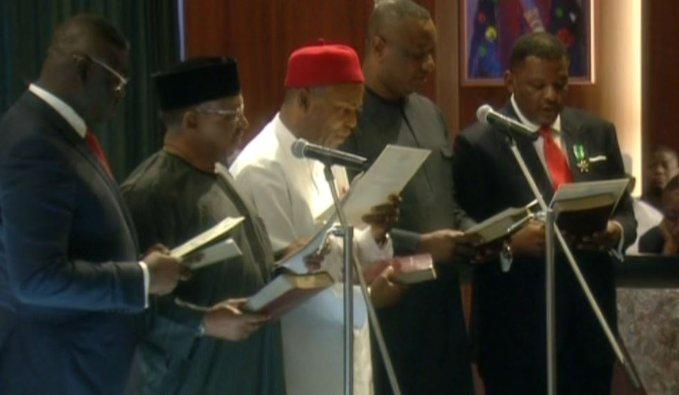
Zainab Ahmed has not only been confirmed as minister of finance, a role she filled in acting capacity for a year, but she’s also going to be combining the job of former minister for budget and national planning, Udo Udoma.
Would be interesting to see how she combines both jobs at a time when the walls seem to be caving in on the economy.
She will lead in the face of lower oil prices, weak government revenue and a huge debt burden. The three factors threatening a fiscal crisis. She will also find tapping debt to make up for lower government revenues is almost a non-existent option. Not when the federal government’s debt to revenue ratio is already at unsustainable levels.

Fashola’s lighter burden
Babatunde Fashola has been stripped of the power ministry and will now focus on works and housing. Sale Mamman has been given the nod by Buhari to have a go at fixing Nigeria’s power conundrum. Mamman will have a fresh start in attempting to fix the legacy problems bedeviling the sector.
Adeniyi Adebayo is new minister of investment, trade and industry
Adebayo, 61, will take the position of former minister Okechukwu Enelamah, as the new minister of investment, trade and ministry.
The University of Lagos law graduate is a veteran politician. He was the first Executive Governor of Ekiti State and is a top chieftain at the ruling All Progressives Congress (APC).

He faces an unenviable task of building investors’ confidence in an economy still struggling with weak growth.
Foreign direct investments (FDI) into Africa’s biggest economy tanked after a 2014 collapse in global oil prices, coupled with an agitation in the Niger Delta region that curbed production. Investment flows have not really recovered since then, despite improvement from 2016’s record low.
Data from the National Bureau of Statistics show that investment into the country dropped 53.5 percent in 2015 to $9.8 billion from $20.7 billion in 2014.
At the thick of the recession in 2016, the figure reached its lowest level at $5.1 billion. In 2017, foreign investment picked up to $12 billion and climbed further to $17 billion in 2018, which remains some way off the $20 billion inflow of 2014.
LOLADE AKINMURELE