When you relax in a hotel lounge, bar or even at home to enjoy a sip of the Jameson brand of whisky, you often don’t know the process and efforts the distillers put in to ensure rare quality drink offerings.
One of such efforts is coopering; a craft, which only the very skilled plies.
The craft involves a cooper, who is trained to make wooden casks, barrels, and other staved containers from timber for aging the finest blends of whisky, cognac and so on.
Ger Buckley, foremost cooper for Jameson, is top among the skilled in the art of coopering in the world today.

Buckley, the master cooper at Jameson‘s Midleton distillery in Ireland, is also a fifth-generation master cooper, who is keeping the family legacy of over 200 years.
“I have been practicing as a cooper for almost 44 years and my family have been coopers for well over 200 years”, he says.
At Midleton, he is in charge of the distillery’s barrels; repairing cracks and other damages in the staves so they do not leak during the years of aging it takes to mature a whiskey. This he does by hand, in his moldering cooperage filled with mottled barrels, often using only traditional tools.
“My team and I in Midleton are responsible for 1.6M barrels. I am directly involved with supervising the quality of barrels that we buy from our suppliers in Spain, France, Hungry and the U.S”, he says.
The intrigue of the craft is that while lots of machinery with technicians can build as many as 2,000 barrels a day, but if the barrels need repair, they must go to the coopers’ because “we are the only ones that still know how to properly repair a barrel. However, in Spain or France, it is still the coopers that are making the barrels”.

But while whisky is synonymous to Ireland, Buckley says barrel making is an African craft, which started in Egypt four and a half thousand years ago.
“It is essentially the same thing it was back then and it hasn’t changed. Imagine if I was to go back to Egyptian times 4,000 years ago, I’d be doing the same work”, he says.
He insists that if one wants to make a barrel to hold whiskey, “you have to be good at it as the barrel should be able to hold it for 30 – 40 years.
You must also mark every barrel with your signature. For me it’s a mark I inherited from my Dad and my Grandad, so its Number 1”.
Explaining the importance of the barrels to the whisky, Buckley says the first thing is making the right choice of wood, which is the white oak timber because it is strong, and does not taint the wine like other woods.
Explaining further, he says, aging whiskey in barrels gives it 100 percent of its color, and depending on the age of the whiskey, up to 50 percent of the taste can come from the wood.
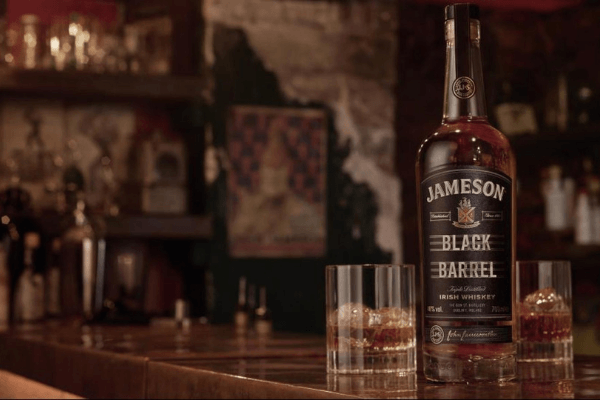
Beyond the above details, he says Jameson Black Barrel is unique for some reasons. “First, when we distill it in the barrel we do it differently. Normally when we make grain whiskey we put it through a column still, which is a continuous still and it does three distillations. But with the Jameson Black Barrel, the first distillation is done in a pot still, which is a huge metal copper pot. The next two distillations are in the column which gives a very unique batch of whiskey. We only do it one day in a year and the process is slow and takes a lot of stills”, he explains.
America also offers choice wood. Once a year, he takes a trip to Kentucky, United States of America, to supervise the double charring of barrels for storing of cognac and whiskey. While that implies cooking the wood, it helps to caramelize, and crystallize all the sugars, vanilla notes in the oak. “What we do with Jameson Black Barrel and in the whiskey business is that we char the inside of the barrel. That’s essentially the deeper cooking of the barrel, where you caramelize, crystalize much deeper.
“You get a lot more sweetness, a lot more vanilla, caramel and toffee notes, when you cook the wood. That is why Jameson Black Barrel has that real genuine sweetness. It is one of my favourite products from Jameson as I like the sweetness you get from the American wood.”
He notes that Midleton distillery, where Jameson is produced, has a lot going for it in terms of history, capacity and quality.
A merger of the big distilleries ( Jameson, Millers, and Cork) in Ireland in 1966 resulted in Irish Distillers with a major, now modern distillery in Midleton whose distils are the biggest in the world despite being handmade.
As well, the whiskey there is also different because it is triple distilled, which makes it purer, milder and more refined.
Speaking more on why Irish Whisky is premium to others, especially Scotch or Bourbon whiskies, Buckley says, “We use grain whiskey which is from the column still except in this occasion where we do the first still in the pan. We use some sherry, mainly American casks and double charred barrel which makes a difference to the final oak. The uniqueness of Irish whiskey brand is the triple distillation, the use of malted and un-malted barley, barrel types. These are things that make Jameson and Jameson Black Barrel in particular, so unique.”
For the last couple of years he has also been involved in teaching, and conducting seminars on barrel making, the effect of wood and how much it affects the taste. “Depending on the age of your whiskey, if it is an old whiskey, 60 – 70% of the taste is from the wood. The wood has a huge influence on the fine finish of the whiskey”.
But when creating the products, he thinks of new drinkers that are starting to develop a taste for all whiskeys, including Jameson. “We wanted to give them a further experience and a step up for target consumers who may have some knowledge of whiskey and Jameson”.
The step up for him is the Black Barrel, which is Jameson’s big brother. It is more mature and a bit more complex.
Explaining the inspiration behind Jameson Black Barrel, he says, “The inspiration was for us to elevate the Jameson Original, almost for it to become Jameson’s big brother. In that, it is a bit more sophisticated, a bit more mature, a bit older, a bit more complicated”.
While there are no perfect ways of enjoying the Jameson Black Barrel, he likes it neat, sniffs to get the aromas and sip afterwards. He also adds drops of water, milk or chocolate.
For him, Jameson will continue to experiment with new techniques and flavours because Jameson Black Barrel was a trial, As well, over the last eight or nine years, “We have released at least two of three new styles of whisky every year some of them only go one batch and others might get repeated and so we are constantly pushing the envelope”, he concludes.