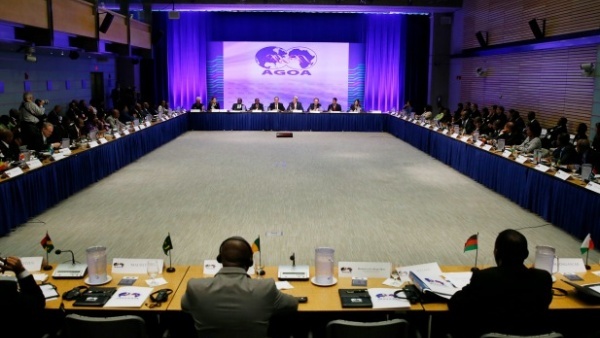
The United States government, through its Bureau of African Affairs is calling for participation in the new bilateral free trade agreement (FTA) with Africa as the Africa Growth and Opportunity Act (AGOA) ends in the year 2025.
This call was made jointly by Ambassador Tibor P. Nagy, Assistant Secretary, Bureau of African Affairs, and Constance Hamilton, Assistant U.S. Trade Representative for Africa during Telephonic Press Briefing on Tuesday.
AGOA opens the door for opportunities for entrepreneurs and farmers and businesspeople to get their products into the United States market.
“We are urging countries to continue to maximize what they’re doing under AGOA, to really take advantage of it while it still exists, and we’re also urging those partners who are interested in our FTA initiative to reach out to us and let us know. Keep in mind that the United States is the largest single-country market in the world, and the best way to secure access into that market is through an FTA. And so we are encouraging countries to think about what comes next post-AGOA,” Hamilton said.

She encouraged Nigerian government to in the next six years, think about how to maximize the benefits of AGOA.
“I really think that the question for the Nigerian government is how do we take better advantage of the opportunities that AGOA presents? I mean, we have opened the door; we’ve got the trade hubs there to provide assistance to individual entrepreneurs, but it’s up to the government to create the conditions and to provide its businesspeople with what they need to access this market. We’ve been saying that over and over again”.
Giving an extensive background on AGOA and on the U.S. government’s focus on free trade agreements, Hamilton highlighted a number of other major initiatives by the administration to boost our trade and investment with Africa and to really leap towards Africa’s prosperity.
One of the initiatives, which was recently announced at the Corporate Council for Africa Summit in Maputo is Prosper Africa, which will be a major initiative. Then another one, which was announced earlier, is the Build Act, which will lead to the creation of the International Development Finance Corporation and double OPIC’s available capital for investment in Africa and other developing countries to $60 billion, and then a new policy announced for the Millennium Challenge Corporation, which will allow MCC to do regional compacts instead of bilateral compacts.
For almost two decades, AGOA has been the cornerstone of the United States’ economic engagement with sub-Saharan Africa, and during that time the U.S has invested heavily to help African countries better utilize AGOA, including creation of the trade hubs as resources for African businesses and entrepreneurs, and allocating more than $7 billion for trade capacity building initiatives.

Last year, the top five AGOA beneficiaries accounted for more than 75% of AGOA exports. In the strategic textiles and apparel sector, the top five countries accounted for 95% of AGOA apparel exports.
Petroleum products continued to account for the largest portion of AGOA imports, with a 67% share. And the volume of AGOA trade remains modest. In the AGOA clothing sector, for example, we get about $1 billion per year from Africa, but that’s just roughly 1% of the United States’ $95 billion imports in global clothing imports. To maximize AGOA, countries must take an active role in creating the competitive conditions in which companies, entrepreneurs, and farmers can thrive. The AGOA’s eligibility criteria were designed to help improve these conditions.
HOPE MOSES-ASHIKE