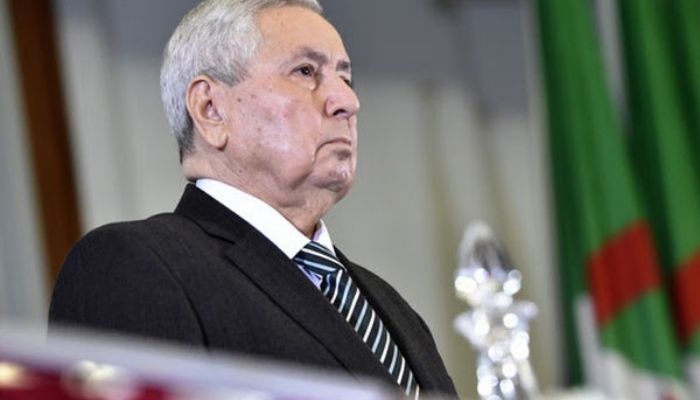
Algeria’s parliament has appointed upper house speaker Abdelkader Bensalah as the country’s interim president, to lead the government as it prepares for fresh elections.
The 76-year-old regime insider takes over a week after the resignation of Abdelaziz Bouteflika, the ailing president who was forced to step down after more than a month of mass protests. Mr Bensalah will lead the gas-rich North African country for a period of three months, as elections are planned.
In a televised speech on Tuesday night, he pledged to organize free and fair elections and to consult with the political class and civil society to build a “new Algeria”.
But while Mr Bensalah’s switch to the presidency is in line with the constitution, his appointment has already been rejected by protesters who are demanding sweeping democratic reforms. They say the arrangement is a ploy by a corrupt and unaccountable Algerian establishment to ensure its survival under a new leadership.

Thousands of students angry at the appointment demonstrated on Tuesday in several cities including the capital Algiers where, for the first time since the start of the protests, police cracked down hard, using batons, tear gas and water cannons to disperse demonstrators.
The continuing protests are a challenge to Ahmed Gaid Salah, the army chief of staff who had been an ally of Mr Bouteflika before belatedly ditching him when it became clear that the protests were gaining momentum. The military delivered the final push to dislodge the 82-year-old after backing his candidacy for a fifth term as president.
READ ALSO: Algeria, other peers leave Nigeria behind in chase for oil investment
The army is the most powerful institution in the country and has long played the role of arbiter between political factions and their associated networks of vested interest.
But while the armed forces insists it wants to stick to the constitution to preserve stability, the protesters believe an entire hierarchy of officials should go to make way for new faces in a reformed political system.

Yet the military is unlikely to be comfortable with calls for radical reforms to dismantle a deeply entrenched system in which it is a central pillar. In addition, the generals are likely to view any attempt at extensive change as destabilising in a country with weak political institutions.
Algeria has a fragmented political opposition that was marginalised under Mr Bouteflika. It cannot claim to speak for the protesters who have come out in their hundreds of thousands every week to signal their frustrations.
With little sign that the demonstrators are prepared to back down and more protests expected, analysts believe Gen Salah may be forced into further concessions.
Heba Saleh, FT