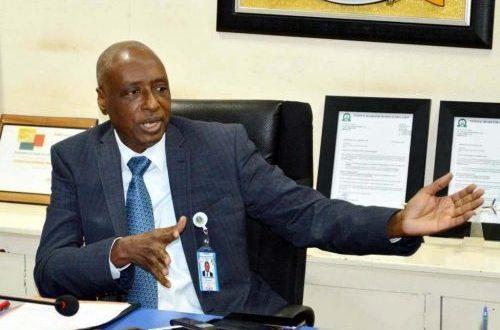
Abdulsalam Mohammed, is the rector of the Nigerian College of Aviation Technology (NCAT) in Zaria. NCAT is Nigeria’s foremost aviation school. In this interview with Ifeoma Okeke, he speaks about the achievements of the college.
How many aircraft have you acquired in the past few months and what are your plans to improve on this?
On the issue of aircraft acquisition, the approval we have from the government is to acquire 20 Diamond aircraft, five of which are the two-engine DA42 and 15 Assembly engine DA 40 aircraft. When I assumed office in 2017, we took delivery of one DA 42 aircraft in the April of 2017. The college placed orders for additional aircraft but we were informed by the contractors that the Diamond Aircraft Company was bought over by another company and that new owner decided to relocate the production place from Austria to Canada and they told us that they won’t be able to produce another aircraft until nine to 10 months, which is when the assembly line would have been completely relocated.
That is what affected the delivery of the additional aircraft because we asked for four additional DA 40 aircraft, which is what we have on order now. That company is up and running in Canada now and we expect to take delivery of those four DA 40 aircraft before the end of this year. We also have additional DA 40 aircraft that was given to the college by an insurance company as part from an insurance settlement. So, by the time we have the four aircraft delivered, we will have one DA 42 and five DA 40. As of today, we have eight aircraft that are serviceable.

NCAT was recently named as the Regional Training Centre of Excellence by the International Civil Aviation Organisation (ICAO), how has this impacted on your operations?
The Regional Training Centre of Excellence (RTCE) has given NCAT more visibility worldwide. For instance, I was in China last December and a Chinese man asked me where I worked from and immediately I mentioned NCAT, he said ‘oh, RTCE’. There are just few RTCEs in the world and it takes a lot of efforts and process before any institution is recognised as an RTCE. Now, when you have this status, it affords you the opportunity to develop courses in all the ICAO Annexes. We can also import courses from any part of the world that are ICAO approved courses and conduct them here. With RTCE, the sky is actually the limit for us as we can run any course. Right now, we have some foreign students in the college; some from Cameroon, some from the Gambia who are doing training and we expect more.
I am supposed to meet with the representatives of the Western and Central African Region of ICAO. The countries that are in this region have headquarters in Dakar. They have indicated interest in whatever NCAT is doing. I am supposed to have a meeting with them on the training opportunities here at the college. A lot of them that I met recently had this misconception that Zaria is insecure and that is the main reason they are reluctant to come. We have gone to great length to convince them that Zaria is totally safe. We have had a lot of foreigners come and go. Some of these people claimed that it is their embassies that tell them that Zaria is not safe, but we are making efforts to disabuse people’s minds in this regards.
What is your collaboration with Babcock University and other institutions in the country offering aviation courses?
We don’t have any collaboration with Babcock but we are making a lot of efforts to collaborate with some of the universities around. I just returned from Tunisia and I was actually asked to join the Bilateral Air Services Agreement (BASA) team between Nigeria and Tunisia, at the request of Tunisia. Tunisia wants a representative of NCAT to be part of the team because the country wants to collaborate with the institution. So, we are making efforts on this issue. We had the Vice Chancellor of Macdonald University with us in 2018 and it wants to set up an aircraft maintenance engineering school there and they have approached us for help in seeing this dream come to reality.

NCAT attempted to acquire a simulation aircraft, Boeing 737, how far has the institution gone with this process?
The initial plan for the Boeing 737 simulator aircraft was for it to be based in Lagos when the contract was awarded, but when this administration came into power, they took the decision to relocate it to Zaria. As we speak, the simulator is being installed in Zaria. So, when that decision was made, we had to move because the contract did not include the housing of the simulator. The contract was for acquisition and installation of Boeing 737simulator. So, we looked at our existing facilities; if they were adequate to house the simulator, but the simulator manufacturer after seeing the dimension, said the building was inadequate. When we looked at the cost of modifying and building another one to accommodate the simulator, so, we decided to make an arrangement to build a new complex that will house the simulator. So, we have to now start the process from the scratch; we have to get consultants, get the plan approved by the manufacturer before we could go forward. We had to go to the Federal Executive Council (FEC) for the contract to be awarded. It was only last year that we got FEC approval for the building. We have awarded the contract and it is our belief that the building would be completed and the simulator would be installed this year.
The simulator has been constructed, but it is waiting for shipment; it is too big to enter a container. So, when they bring it in the counter, they won’t be able to cover it. So, if they bring it in and the building is not ready, it would be exposed to the elements and that is why the manufacturer advised us not to expose it until the building is ready. This simulator is very sensitive to temperature and humidity and all the parts were made by Boeing. We believe that the stimulator would be installed this year.
In addition, we also have another simulator that is being installed in Zaria this year. The simulator is for firemen. It is automatic fire simulator. As you may be aware, we have never had fire simulator in Nigeria in spite of the number of firemen that we have in this country, all these years, we have been sending our firemen to Cameroon for training. So, this administration felt it is more economical for us to have our own simulator here in Nigeria and this decision was taken to house it here because we have the land. The simulator is being built in the United Kingdom.
There was an advert in the media recently where NCAT said it wants to commence Post Graduate Diploma (PGD) programme in aviation in Lagos. Can you throw more lights on this?
NCAT is not going to have a campus in Lagos; if you remember, this administration suspended all works for campuses outside Zaria for the college, rather, we are concentrating on developing NCAT first before moving anywhere. We have a Memorandum of Understanding (MoU) with a sister organisation in Lagos that has training schools. We hope to use their training facilities and send the instructors to Lagos to conduct this.
As part of our efforts to expand our client base and increase our Internally Generated Revenue (IGR), we have two teams, which are called Reach Teams to interact with the airlines and other industry players on their training needs. A lot of them showed interests in the courses that we are running here, but the major constraint is that they don’t want to leave Lagos. For these courses that we will be running outside Lagos, we intend to be running them on a regular basis. That way, we also have some aircraft engineers who have indicated interest in running some of these Higher National Diploma (HND) programmes that we have been accredited to do. They have indicated interest in pursuing those programmes. So, you will be seeing some of these programmes being run out of Lagos in the near future.
What are the sustainability plans the school has for the RTCE?
ICAO that gives you the RTCE status has a lot of expectations from you. There are a lot of things you have to do to retain the status and if you don’t do, they will yank it from you. One of such is that you have to develop an ICAO Training Package (ITP); we have to be able to train people from outside the country since it is for the region. We are not a local organisation, but now a regional organisation.
During the certification process, you are required to develop a certain number of other training packages. The minimum requirement to qualify as an RTCE are three. It used to be one and we were the first to go to three when it was changed from one to three. At the time NCAT became an RTCE, we had developed six standard training packages and we hope to develop three additional packages before the end of this year.
Right now, we are about one of the institutions with the highest number of packages developed, which is what has been acknowledged by ICAO in their reports to the President of the Council. There are lots of things that we are doing and we are up to the task of sustaining this RTCE status.