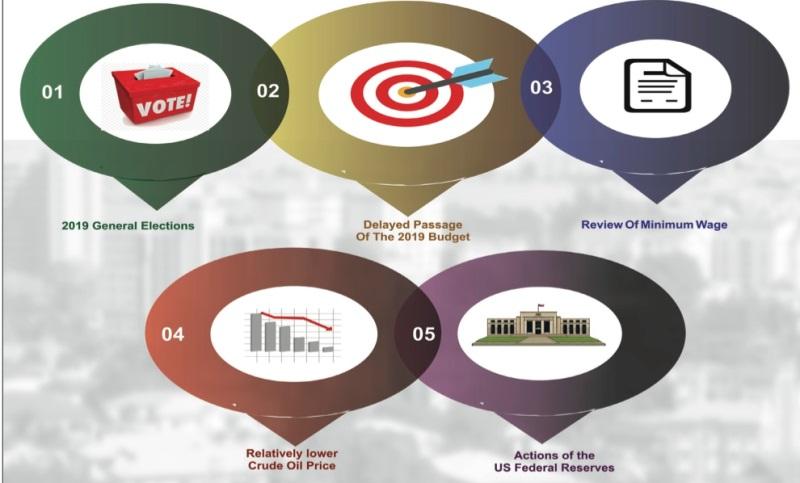
The 2019 general elections, delayed passage of the budget, review of minimum wage, relatively lower crude oil price, and actions of the US Federal Reserve are the key factors that would shape Nigeria’s economy in 2019, the Nigerian Economic Summit Group (NESG) said on Monday.
NESG, one of the most influential think-thank groups in Nigeria, noted that the outcome of the elections will likely shape “investment policies, debt management, public sector spending, security and governance reforms, etc”.
Delayed passage of the proposed 2019 budget of N8.73 trillion, which is a reduction from 2018’s N9.12 trillion and an indication of fiscal tightening measures by the government, was also stated as one of the events that will impact the country’s performance in 2019.
“It is expected, however, that this budget would not be passed until the second or third quarter of the year, after the general elections,” NESG said.
The independent, Lagos-based NESG acknowledged that the review of the minimum wage from N18,000 to N30,000 will result in higher government spending at both federal and state level, adding, “Some state governments might experience difficulty in meeting salary obligations in the year.”

With Organisation of Petroleum Exporting Countries (OPEC) projecting growth in world oil demand by 1.36mbpd to reach 100.15mbpd in 2019 and several projections expecting crude oil price to likely hover around $60 per barrel, NESG noted that “this development, coupled with slow growth in Nigeria’s oil output, might trigger some fiscal challenges in the year”.
Concerning the US Federal Reserves, it said, “There are indications that the Federal Reserve would hike the interest rate, which could cause further negative effects on Nigeria’s foreign portfolio investment.”
Doyin Salami, NESG’s research director, said the Nigerian government must focus on choosing pro-growth currency management approach and also decide what it wants to do with the private sector or private capital if it wants to drive growth.
Stakeholders have long called for Nigeria to liberalise its currency regime, mostly multiple exchange rate system, which not only promotes currency speculation and trafficking at the expense of real production domestically but also provides avenue for milking government revenue.
The main opposition candidate for next month’s presidential election, Atiku Abubakar, a businessman who served as vice president between 1999 and 2007, said he would scrap multiple exchange rates to attract foreign investors.

Salami, while buttressing the points in the report, explained that the way the government has run the economy so far, including its rising debt burden, has showed the need and importance of private capital.
Salami, who is associate professor and member of the faculty at the Lagos Business School, said that private sector does not necessarily mean foreign capital but also includes local capital because foreign capital can’t come in when local capital is leaving. Therefore, he said, the government put up deliberate strategies to retain local capital and attract foreign capital inflows.
Members of NESG were bothered that Nigeria is suddenly thinking small and unambitious, unlike before when the economy was growing within 6 percent to 7 percent, which economists say could further grow to 13 percent if the country could fix the power sector.
NESG said it is not really more about what Nigeria is doing right or wrong but what other countries are doing.
For example, the group raised concerns about other African countries like South Africa, Rwanda, Kenya, Ethiopia and Mozambique intensifying reforms and positioning themselves to attract FDI.
Also, if US Fed hikes its rate and emerging markets are affected, it said, the remaining capital in emerging market would elude Nigeria and go to other countries that are doing a lot to attract investors.
NESG was disturbed about the lack of coordination among various agencies and ministries. For example, it said, Ngozi Okonjo-Iweala, a former finance minister, was actively controlling and influencing decisions in other government agencies as the controlling minister. It noted that the attitude in government today is that the ministers work in silos, unlike Okonjo-Iweala’s days when she had mandate to get things done.
Responding to the report, Rafiq Raji, chief economist at Macroafricaintel, said, “I agree with the NESG.”
Omotola Abimbola, fixed income and currency researcher at Ecobank Research, said the policies and happenings are all very key to the economy and financial markets outlook for 2019.
“However, if the Fed maintains the dovish narrative seen since the start of the year and oil prices stay above USD60/barrel, that could provide a favourable backdrop for financial market performance post- elections,” Abimbola told BusinessDay.
NESG further had macroeconomic projection for 2019 listed in three scenarios that could play out.
Best case scenario
Under this scenario, the planned 1.2mbpd oil production cut by OPEC and its allies is implemented as scheduled while oil producers maintain production cuts to keep oil price at $75 per barrel, which is above Nigeria’s US$60 2019 budget benchmark price. In addition, improved US-China trade negotiations as well as the slow and gradual pace of implementing the rate increase by the US Fed will have a favourable outlook on the global economy in the year.
Implication
According to NESG, the expiration of the supply cut exemption means that Nigeria will have to comply with the scheduled OPEC cuts in 2019. Crude oil production will, therefore, hover around 1.8mbpd.
“In terms of government spending, we assume actual disbursement of N1.4 trillion for capital projects in the calendar year, based on improved government revenue,” it said.
This implies a budget implementation rate of 70 percent which will lead to real GDP growth of 3.2 percent in 2019 driven by Information, Communication and Technology (ICT) and agriculture sectors, while inflation moderates at 11 percent in the year, largely as a result of increased agriculture outputs and a stable official exchange rate at N302/$. Also, unemployment and underemployment rates are projected to decline marginally by 21.5 percent and 20.5 percent, respectively, while government revenue improves by 20 percent in the year.
Business-as-usual scenario
This scenario assumes the continuation of the US-China trade war and a lack of tangible progress in the negotiations between both countries. In addition, several estimates show that China’s economy will record a slow growth in 2019, which could adversely affect global oil demand and weaken oil price in the year. However, agreements between OPEC and non-OPEC producers will likely intervene to keep oil price around US$60 per barrel.
On the domestic front, uncertainties persist in the oil and gas industry due to non-passage of the Petroleum Industry Bill (PIB). Domestic oil production averages 1.7 mbpd in the year. In addition, the government implements 60 percent of its proposed capital expenditure budget in 2019.
Implication
Real GDP grows by 2.1 percent in 2019. Government revenue increases slightly by 5 percent. Exchange rate and external reserves face moderate pressure due to FX outflows arising from uncertainties from the 2019 general elections. Inflation rate hovers around 10.5 percent while unemployment and underemployment rate rises to 22 percent and 23 percent, respectively.
Worst case scenario
Global GDP growth weakens in the year, occasioned by rising interest rates in developed markets and huge capital outflows in emerging and developing markets. China’s GDP growth slows in the year as the US-China trade war worsens. These factors, along with increased production and supply on crude oil from North America in the second half of 2019, threaten crude oil price, which averages $45 per barrel in the year. In Nigeria, post-election uncertainties and agitation in the Niger Delta force production down to 1.4 mbpd in 2019. The Federal Government injects N700 billion into capital projects in the year.
Implication
Nigerian economy falls into a recession as real GDP grows by -1.1 percent, triggered by fall in oil price and output. Inflation rate rises to 14 percent while government revenue declines by 16 percent. The CBN is forced to devalue the official exchange rate to N350/US$, while the parallel market experiences supply shortage and severe depreciation. Unemployment and underemployment rate increases to 24 percent each in the year.
DIPO OLADEHINDE & ENDURANCE OKAFOR