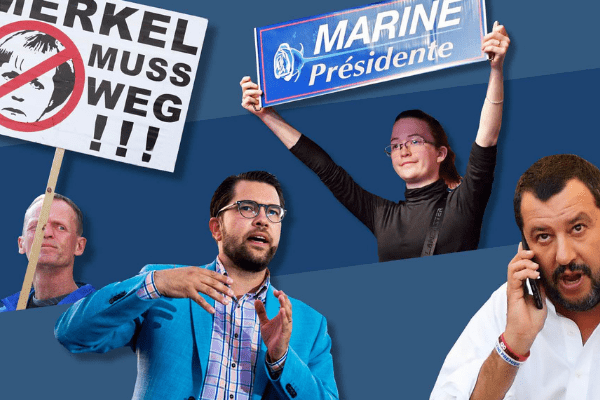
When a Spanish nationalist party took 12 seats in Andalucia’s parliament last month, it was not just the latest example of rising populism in Europe. It also demonstrated a deeper trend that threatens to disrupt governance across the continent — the fragmentation of electorates and the parties that represent them.
Representation has splintered in almost every sizeable political system in Europe, making it harder to form governing coalitions, creating political instability and giving a voice to new formations on the radical left and right and in the political centre.
“You have new dimensions in politics today,” said Hans Wallmark, a centre-right MP from Sweden. “Pessimists-optimists, centre-periphery. It is not so easy as when you had a left-right scale on which you could plot political choices.
“It is not necessarily a chaotic system, but a new political landscape is taking shape,” he added. “We are going to see it for many years.”

Before the Andalucía breakthrough by Vox— in a country previously considered immune to far-right politics because of its Francoist past — Spain was already a four-party system, with socialists, the far-left, centre-right and liberals vying for power. If Vox establishes a national appeal, there will be five, plus a smattering of Catalan, Basque and Galician nationalists. Opinion polls suggest no party nationally enjoys backing of more than 24 per cent.
In Belgium, meanwhile, it took the country a world record 541 days to form a government after inconclusive elections in 2010. Following the country’s 2014 polls, in which eight parties won between 33 and six seats each, it took five months to assemble a coalition — which collapsed last month.
Mr Wallmark’s Sweden could be heading for more elections this year after parties failed to form a government following September’s poll. No party wants to co-operate with the far-right Sweden Democrats, who won 17.5 per cent in the vote, but that means neither a centre-left nor a centre-right bloc can muster a majority in parliament.
The losers from the fragmentation of European politics have mostly been mainstream centre-left and centre-right parties, as in Germany, where the populist rightwing Alternative for Germany and the left-leaning Greens have eaten into support for the Christian Democrats and Social Democrats. In May’s European Parliament elections, the centre-left and centre-right blocs are likely to lose their majority for the first time in 25 years.
Tarik Abou-Chadi, assistant professor at the University of Zurich and Centre for Democracy Studies Aarau, said three deep-seated reasons lay behind the trend: societies were becoming more individualised; big organisations such as trade unions, churches and political parties were “losing their capacity to link voters to a particular identity”; and political debate was becoming more “multi-dimensional”.

For example, he argued, it was no longer about capital versus labour, while some social liberals as well as conservatives now opposed immigration.
Mainstream parties, Prof Abou-Chadi said, were increasingly less able to react quickly to new concerns and issues. They were “like the old department stores of the 1960s competing with cool new boutiques”.
The most extreme example of such fragmentation is the Netherlands. Thanks to a highly proportional voting system, 13 parties won seats in the 150-strong assembly there in the 2017 general election. The coalition government is made up of four parties and took office 225 days after voters cast their ballots. Indeed, some analysts have described the fragmentation trend as “Dutchification”.
Prof Sarah de Lange, of the University of Amsterdam, said the Dutch had seen a proliferation of parties before, in the 1960s and 1970s, but without today’s range of political positions.
“The incumbents have become smaller and the newcomers have got bigger,” she said. “At the same time, the political poles have grown further apart. It is these two developments that have made it harder to govern.”
There are exceptions in Europe, mostly because of differences in political systems. France’s constitution, which provides for two rounds of voting in presidential and National Assembly elections, both encourages fragmentation and then eliminates it.
In 2002 a fractured left failed to back socialist candidate Lionel Jospin in the first round of presidential elections. This gave the then far-right leader Jean-Marie Le Pen a place in the run-off, before Jaques Chirac defeated him in the second round.
Emmanuel Macron won only 24 per cent in the first round vote in the 2017 presidential polls, and three other candidates drew only about 20 per cent each, giving National Front leader Marine Le Pen a place in the run-off. But Mr Macron took the presidency with 66 per cent in the second round.
Now some Macron allies are urging gilets jaunes anti-government protesters to stand in the European elections, a strategy that could help eat into Ms Le Pen’s support.
Britain’s first-past-the-post electoral system obscures its political fragmentation. Some 82 per cent of voters backed either the Labour or Conservative parties at the 2017 general election, but the two have deep internal divisions on many issues and would be likely to split under a more proportional system.
But to many voters, political diversification may be positive. “People like congruent choice,” said Prof Sara Hobolt, of the London School of Economics. “They like to have parties that represent their views.
“But they also like politicians to do effective governance,” she said. “There is always a trade-off between responsibility and responsiveness. What if they cannot deliver?”