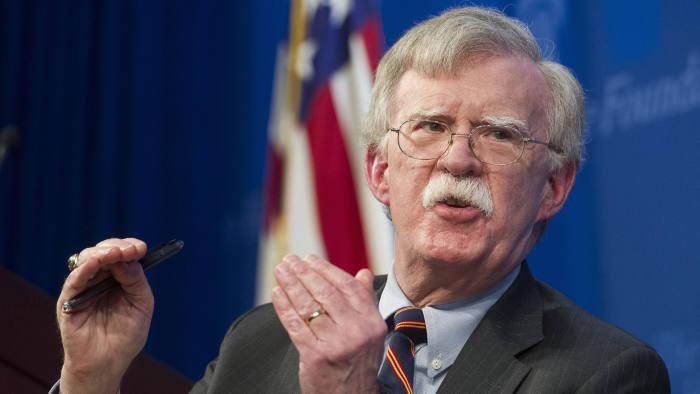
The Trump administration has unveiled what John Bolton, the national security adviser, has billed as a “new” Africa strategy for the US. On the commercial front there is indeed some fresh thinking. But much of what Mr Bolton says has emerged from a detailed inter-agency debate about America’s future engagement with the continent, seems to belong in the past. If his speech on Friday is the guide, Washington’s take on Africa is stuck somewhere between the 19th century scramble and the cold war, when the continent played proxy for superpower rivalry.
Mr Bolton depicts US relations with Africa as a geostrategic board game in which Africans have less agency than a pawn. Whatever “predatory” moves by Chinese and Russian policymakers may be going on, he somehow finds America to be the principal victim.
“Great power competitors, namely China and Russia, are rapidly expanding their financial and political influence across Africa. They are deliberately and aggressively targeting their investments in the region to gain a competitive advantage over the United States,” Mr Bolton claims. It is unlikely many Africans will welcome the prospect of returning to the era of “us or them” development partners depicted in this vision, or feel much sympathy if America is the one left behind. If the US has lost ground to rivals, it is successive administrations that are to blame. Washington has responded with complacency to the past two decades of changing dynamics on the continent, where bouts of rapid economic expansion have meant the emergence of more assertive governments, a growing consumer class and a host of new suitors from around the world.
The pioneering spirit with which Americans built their nation has been notably absent from US-Africa policy. This has increasingly focused on combating militant Islamists and terrorism, at the expense of a more multi-faceted approach. Mr Bolton is wrong to see China’s role on the continent as uniquely negative. While Washington has been otherwise occupied, Beijing has adopted a long-term view of Africa’s potential, marrying its own quest for resources and new markets to Africa’s need for infrastructure development and fast money. Moscow, like Washington, is arriving late to the party. Mr Bolton is wrong on another front: past development aid, which he dismisses as “aid without effect” and a waste of US taxpayers’ money.

That is not true of the health initiatives launched by George W Bush, the previous Republican president, and which saved countless lives. Moreover, the benefits — in terms of exerting stronger US influence — of the stricter aid conditionality he recommends have been diluted by China’s willingness to provide billions of dollars in investment, free of politicised conditions. If there is a positive to draw, it is that Washington is waking up to the need to re-engage and that to do so effectively it must place economic ties to Africa up the priority list. The recent passage of legislation that doubles the spending power of the Overseas Private Investment Corporation is one step in the right direction.
Giving a bigger role to the US government agency that handles private sector lending abroad plays to America’s strength by promoting closer business ties. It is a pity, however, that Mr Bolton depicts such measures as designed explicitly to project US power in Africa, rather than to promote reciprocal interests, and to counter the influence of “great power” rivals. Such language is out of step with the times.