



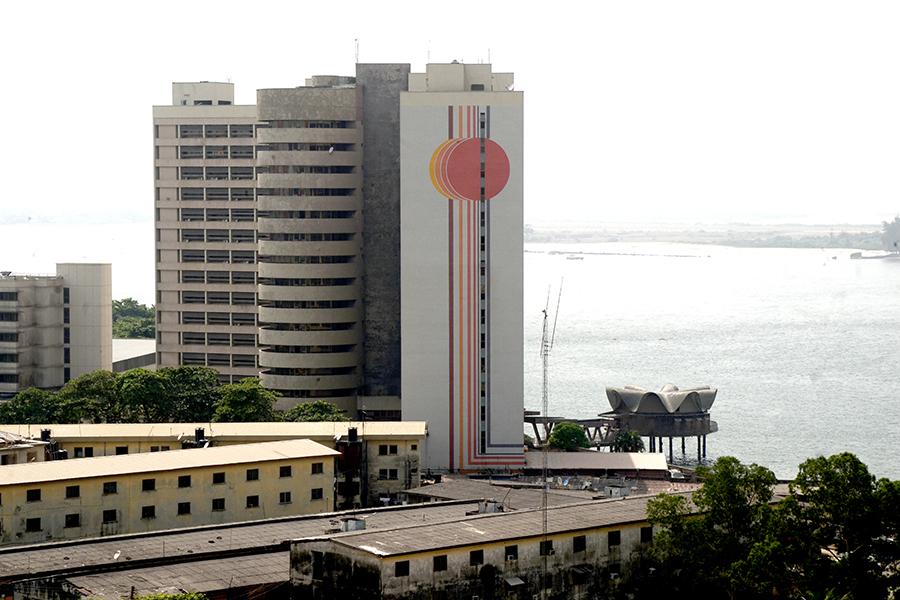
More than three decades after opening its doors to save lives, Shareholders in Eko Hospital one of Lagos’ most popular health facilities will be hoping the only hospital business quoted on the Nigerian Stock Exchange (NSE) under the auspices of Ekocorp Plc will be able to get it acts rights and make profits in 2018.
The company financial performance has been unsteady over the last three years as a decade-long battle between the founders of EKO hospital and Geoffrey Ohen (a major shareholder and an oil and gas magnate) have affected the company’s optimal performance in recent times.
While most firms listed on the NSE have already released their q1 2018 and preparing to release there q2 2018 report, the reverse is the case for Eko Hospital as the company is yet to release its q1 2018 having just recently released its full 2017 report.
Although its revenue have being hovering at N1.3 billion from 2014 to 2017 however it increased slightly to N1.4 billion in 2017 while it recorded a loss before tax of N970 million in 2017, compare to a profit of N96 million in 2016.

“Communication gap exists between the revenue and finance departments, whereby revised invoices raised as a result of disputes in tariffs and inadequate approvals from Health Management Organisations are not communicated by the revenue department to the finance department,” Eko Hospital explained in its 2017 report.
Eko Hospital recorded a loss after tax of N1.2 billion in 2017 compare to a profit after tax of N79.6 million in 2016; The firm also had a negative earnings of N889 million which implies that until the firm generate enough profits to have positive retained earnings it may not be able to dividends .
The firm’s Return on Equity (ROE) which illustrates how effective the company is at turning the cash put into the business into greater gains and growth for the company and investors was negative at 0.34percent in 2017 compared to 4.50 percent in 2016, while in 2015 it stood at 7.22 percent.
Return on Assets (ROA), an indicator of how profitable a company is relative to its total assets dropped to 2.13 percent in 2016 from 4.12 percent in 2015 while in 2017 it had a negative ROA of 0.34 percent.
The percentage of net income generated from a company’s revenue fell to 5.89 percent in 2016 from 10.72 percent in 2015 while in 2017 it had a negative net margin of -0.81 percent. EBITDA margin also fell to 11.11 percent in 2016 from 18.51 percent in 2015

“Unidentified receipts from customers are not adequately investigated; rather they are recognised as other income instead of being credited to the respective customers’ accounts,” Eko Hospital said.
The loss recorded last year was largely due to the company’s decision to write off bad debts and unsubstantiated balances of N983.9 million. A breakdown of the write-off shows that Trade Receivables which represent money due from customers for services rendered comprised a large portion of the write-offs at N929 million.
“A provision for impairment of trade and other receivables is established when there is objective evidence that the Company will not be able to collect all the amounts due according to the original terms of the receivables,”Eko Hospital said.
Also, debt owed by staff amounting to N19 million was also written off which implies that most of the hospital fees owed by most of its customers over the years have now been written off as the company does not see any possibility of recovering them.
“Accounts receivable balances were not tested for impairment by management, hence doubtful and irrecoverable balances were reported as good and recoverable,” Eko Hospital said in its 2017 financials.
The hospital also wrote off what it described as unsubstantiated bank balances of N30.1 million. This implies that these are bank balances that are carried in the company’s books but not found in any bank accounts as the hospital also noted that it had written off its investments in Hope Valley Clinic as it no longer exists.
All efforts in getting an official response concerning the hospital financial situation proved abortive as none of its staff’s members who responded to calls could reply questions from BusinessDay.
Early this month the hospital scheduled an Extra Ordinary General Meeting (EGM) which was later postponed due to an appeal filed by Geoff Ohen Limited against the judgment of a Federal High Court as well as a stay of execution of the same judgment.
Established in 1982 by three medical doctors, Alexander Eneli, Sunday Kuku, and Augustine Obiora, whose first letter of their surnames form the hospital’s name; the hospital had financial challenges as the trio were owe huge debts as a result of salary and emolument arrears from June 2001 to December 2007.
In its attempt to raise funds to meet its financial challenges, the company offered Geoff Ohen Ltd an investment vehicle owned by Geoff Ohen 110 million ordinary shares at N4 each per share.
After he was allotted the 110 million shares by special placing, and in addition to other shares he had acquired from Guaranty Trust Bank Plc, GTB, and Security Swaps; Ohen’s shareholding in Ekocorp Plc jumped to 53 percent from 19 percent shocking the founding directors who all had 11.31 percent each.
Sunday Kuku, one of the founding directors accused Ohen of deception by failing to disclose to the board of directors that he already “illegally” acquired other shares of Ekocorp Plc from GTB and Security Swaps Ltd, who acted as financial adviser and issuing house for the subscription of Ekocorp Plc shares in 1997.
With his new status as the majority shareholder, Ohen moved to block the debt-equity swap of the founding directors insisting that Ekocorp Plc was not indebted to its founding directors, adding that the interest of the directors is only to gather secret profits.
He denied that there was a Board of Directors resolution to create more shares for the purpose of allotting the 110 million shares to him, insisting that the deal had been concluded and he had paid the N440 million three months before the October 2007 Annual General Meeting.
Ohen also denied stalling the company’s Annual General Meeting; instead, accusing the founding directors of “frustrating” efforts to hold the meeting so as to prevent discussion of their plan to disguise secret profits as debts owed them.
The impasse at Ekocorp Plc has led to a deadlock as the public listed company had not held its Annual General Meeting for over three years, a situation that could lead to severe sanctions from statutory agencies.
Ekocorp Plc started off as Mercy Specialist Hospital in 1977 and was incorporated on the 9th of February 1982 as a private limited company by shares. It became a Public Liability Company (Plc) in 1991 and by 1994, the name changed to Ekocorp Plc.









