Nigeria’s population is rising rapidly but food production is not moving in the same trajectory, sparking fears of food insecurity in Africa’s most populous country.
“We are not producing enough currently because farmers are still farming using old farming techniques and our yield per hectare is still very low when compared with other nations of the world,” said Abiodun Olorundenro, chief executive officer, Green Vine Farms.
“Our population is growing very fast and we are yet to increase our productivity. This is even making the few available more expensive for consumers and that is the recent rise in food prices across the country,” Olorundenro said.
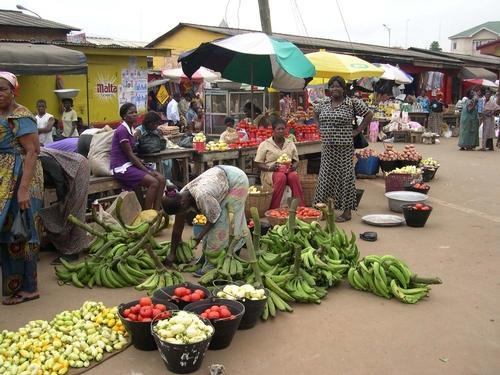
Nigeria is populated by 182 million people who must be fed with staple foods ranging from yams, rice, cassava to beans, bananas and tomatoes.

However, there is still much demand-supply gap in most of the staple foods, even as the population growth rate stands at 2.6 percent per annum. The country’s population is projected to surpass the 300 million people mark by 2050, according to The World Population Prospects 2017.
Latest data from Agriculture Ministry show that Nigeria is the largest producer of yam with 40 million metric tons per annum but yam demand in the country is 60 million metric tonnes per annum (MT), leaving a gap of 20 million MT.
Nigeria produces 42 million MT of cassava but has a demand of 53.8 million MT of the crop, leaving a gap of 11.8 million MT.
National supply for Irish potato is put at 900,000 MT per annum but with a demand of 8million MT and a gap of 7.1 million MT.
Similarly, local production of sweet potato is estimated at 1.2 million MT, while demand is 6million MT, leaving a gap of 4.8 million MT.

More so, Nigeria produces 400,000 MT of wheat annually but with a demand of 4 million MT, which leaves a gap of 3.6million MT.
Nigeria’s ginger production is 310,000 MT but demand is 650,000 MT, leaving a gap of 340,000 MT.
Nigeria’s rice production has risen to 5.3 million MT but demand is still 7.2 million MT, leaving a gap of 1.9 million MT.
Maize production in the country is put at 10.5 million MT but demand is 15 million MT, leaving a gap of 4.5 million mt.
Local Soybean production is 750,000 MT but domestic demand is 2 million MT, meaning there is a gap of 1.3 million MT.
Acha production is 78,000 MT but with local demand reaching 187,000 MT, there is a gap of 109,000 MT. Sesame production is 200,000 MT but demand is 600,000, leaving a gap of 400,000 MT.
Local shea nut production is 200,000 MT but demand is 1.4 million MT, implying there is a gap of 1.2 million MT. Castor production is 014,000 MT. However, demand is 510,000, leaving a gap of 496,000 MT.
Nigeria produces 2.5 million metric tonnes of tomato but citizens need 6 million MT of it to survive, leaving a gap of 3.5 million MT.
Sorghum production in the country is 11 million MT while demand is 12.5 million MT, showing a gap of 1.5 million MT.
“What explains high prices of food in Nigeria?” Bismarck Jewane, CEO of Lagos-based Financial Derivatives Company Limited asked while analysing the 8-year-high food inflation in Nigeria at Channels TV.
“It is either there is high demand for foods or that we are not producing enough. But the answer is that we are not producing enough,” Rewane said.
Ibrahim Kabiru, national president, All Farmers Association of Nigeria, said Nigeria must now increase its mechanisation to meet the ever-increasing mouths needed to be fed.
“We must start farming all year round and provide farmers with improved seeds varieties to increase our yield per hectare to produce enough for our population,” Kabiru told BusinessDay.
Speaking recently at the BusinessDay-organised Agribusiness Summit, Emmanuel Ijewere, vice president of Nigerian Agribusiness Group, said Nigeria must improve its storage to reduce post-harvest losses
“We should stop drawing water in a basket. We send so much energy growing food but allow a lot of it to be lost because we don’t pay enough attention to the value chain,” Ijewere said.
According to Ifeanyi Okeleke, executive director of Kenfrancis Farms, Nigeria can only feed itself and depend less on other countries if there is more private sector investment.
“Government needs to attract more private capital to agriculture. Some of our trees are aging and need to be replenished. Secondly, inputs are expensive and high quality seeds are lacking. We need investments and government intervention in these areas,” he said.
ODINAKA ANUDU & JOSEPHINE OKOJIE