The Nigerian currency has weakened in the past few weeks, as global sentiment towards Emerging Markets sour amid a rollback in the US Fed’s bond buying stimulus programme.
The Naira has however retreated less than other EM currencies vs. the dollar, reflecting the Central Bank of Nigeria’s (CBN), determination to defend the currency to maintain benign inflation expectations and macro-economic stability.
Nigeria currently straddles the Emerging and Frontier markets, with its bonds included in the JPMorgan emerging market bond index (GBI-EM) and its equities in various Frontier market indexes including the MSCI, helping to attract portfolio investor flows.
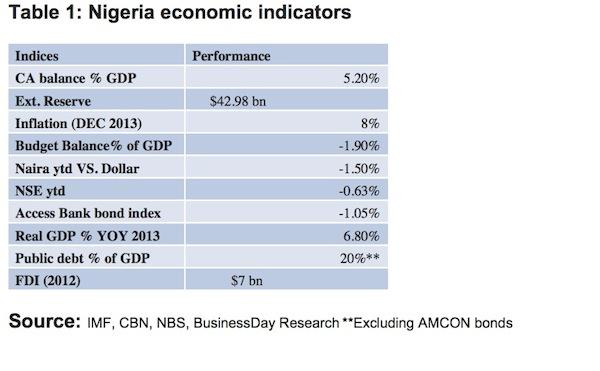

The Nigerian currency has weakened 1.5 percent year to date (ytd) versus the dollar, compared with a 3.7 percent decline for the Ghanaian cedi, 6.1 percent for the South African rand and 7.3 percent, 6.7 percent and 2.1 percent loss for the Russian ruble (RUB), Turkish lira (TRY) and Brazilian real (BRL), respectively.
This defense of the Naira has however come at a price. Nigerian dollar reserves are down 12 percent since their May 2013 peak to $42.98 billion as of Jan. 31, according to CBN data.
The CBN spent $2.989 billion in the month of January in defending the naira at its twice-weekly auctions. The bank also sells dollars directly to lenders as irregular intervals.
The CBN is defending a nominal naira value of plus or minus 3 percent, around 155 per dollar. The naira is however about 5 percent overvalued, when compared to its long term historical trend.
The CBN has hiked interest rates (MPR) to 12 percent to help attract carry trade offshore investors, who are enjoying some of the highest real rates of return in the world with inflation at 8 percent for December 2013. The CBN has also tightened the cash reserve requirements on public sector deposits for banks, in a bid to reduce naira volatility and keep the counter stable.

Foreign Investors currently hold $11.6 billion of Nigerian bonds and Treasury bills equivalent to about 25 percent of Nigeria’s outstanding debt stock. Offshore investors have however begun to slow their rate of purchases of Nigerian sovereign debt in 2014 as the U.S. Fed began reducing its $85 billion in monthly bond purchases.
There are also concerns among investors that government spending is set to escalate before elections in 2015, which may happen if history is a guide.CBN Dollar reserves finished flat in 2011 despite elevated oil prices as Government spending increased 17 percent before the 2011 presidential elections.
This raises the question of the appropriate value of the naira and its role if any in boosting economic growth and output as it is certain that the CBN cannot engage in naira defense indefinitely with the current non- accretion to reserves, due to leakages in oil revenues estimated at up to $10 billion.
Sanusi’s critics argue that a less hawkish monetary policy committee (MPC) would help boost growth, exports and lending.
We tend to disagree with that view, as the ongoing EM turmoil shows us that currencies that have been punished are those of countries were the central bank is not very credible (Turkey), seen as behind the rate curve (South Africa) or inflation is out of control (Argentina).
We however will note that a currency peg that is not credible or leads to overvaluation and black market premiums (such as has emerged in Nigeria), may cause distortion to the financial system, encourage corruption (round tripping) and may even erode the credibility of the CBN in the long run, as markets take their cue from the black market rates, while ignoring the CBN nominal peg.
This is the conundrum the CBN and indeed Nigeria currently faces with regards naira management, and the articulated economic arguments (if any), to support our current naira policy.
By: PATRICK ATUANYA & BALA AUGIE