Guinness Nigeria Plc said consumer spending will probably improve closer to 2015 elections as the government pumps cash into the economy.
“We will see a better economy for the consumer next year and that should factor into better performances,” chief executive officer, Seni Adetu, told Bloomberg in a June 7 phone interview from the company’s headquarters in Lagos. The central bank will be trying “to control liquidity and inflation, but I don’t think it will change the fact that politicians will be spending money,” he said.
Companies including Guinness Nigeria, Nestle Nigeria Plc and Unilever Nigeria Plc have reported falling profit as an acceleration in food inflation to 10 percent and gun and bomb attacks by militant Islamists in northern Nigeria curbed spending. The Federal Government increased its budget 17 percent just before presidential elections in 2011 to fund campaigning and other voting incentives.

Growth in the $269 billion economy will quicken to 7.2 percent this year from 6.3 percent in 2012, International Monetary Fund (IMF) projections show. That compares with an estimated 5.6 percent growth rate for sub-Saharan Africa.
Net income at Guinness Nigeria fell 18 percent to N7.6 billion ($47.2 million) in the nine months through March, while revenue increased 3 percent to N94.9 billion, the company said in a May 13 statement. Guinness Nigeria’s stock has decreased 1.8 percent this year, compared with a 33 percent gain on the Nigerian Stock Exchange All-Share Index.
Nigerian consumer discretionary income has also been subdued by the government’s partial removal of fuel subsidies in January 2012, Adetu said. The World Bank estimates almost 63 percent of the population lives in poverty, or less than $1.25 per day. Food prices soared 10 percent in April from a year earlier, compared with 9.5 percent the previous month, according to the National Bureau of Statistics (NBS).
“The consumer is having to put a lot more into things like transportation, accommodation, food, school fees and so on,” Adetu said. “The beer industry is clearly feeling the impact of that and the market is sort of flat or declining marginally.”
President Goodluck Jonathan imposed emergency rule in the states of Borno, Yobe and Adamawa on May 14 to step up the fight against Islamist militants, who he said were taking over parts of the country. The armed forces then began an air and ground offensive against the organisation, Boko Haram.

The conflict will “hinder the transportation of agriculture products,” potentially increasing food inflation further, Adetu said. The insurgency has “absolutely impeded” Guinness Nigeria alongside several other companies, he said.
Nigeria is the biggest market globally for Guinness stout by net revenue, Adetu said. The first Guinness brewery outside of Ireland and Britain was built in Lagos in 1963 and the unit listed on the national bourse in 1965, according to the company’s website.
Guinness Nigeria also sells Harp lager and non-alcoholic malt beverages and has about a 30 percent share of the country’s beer market, according to Adetu. Nigeria’s biggest brewer is Nigerian Breweries Plc (NB), owned by Amsterdam-based Heineken NV.
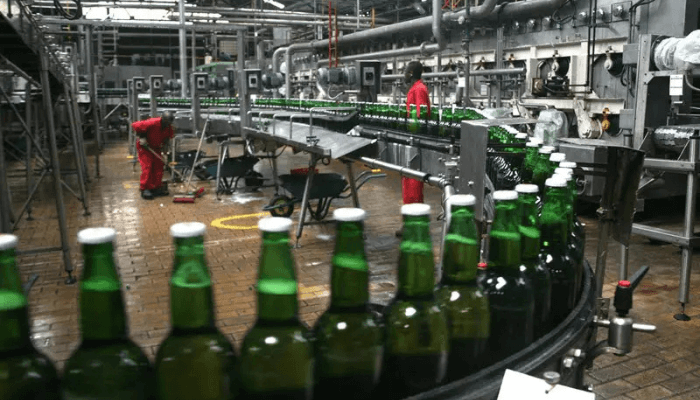
A 225 million pounds ($352.5 million) expansion of the company’s Benin and Ogba breweries will be close to 90 percent complete by the end of the company’s fiscal year, Adetu said.