| Index | Market Returns in First Quarter 2018 (March 2018) | Market Returns April 27,2018 | Market Returns April 28, 2017 |
| All Share Index(ASI) | 8.53% | 7.85% | -4.15% |
| NSE Premium Index | 15.06% | 14.96% | -5.67% |
| NSE Main Board Index | 4.71% | 7.32% | -2.25% |
| NSE ASeM Index | -9.09% | -11.85% | 0.49% |
| NSE 30 Index | 7.30% | 7.36% | -3.03% |
| NSE Banking Index | 9.49% | 8.84% | 3.71% |
| NSE Insurance Index | 8.41% | 4.58% | -1.90% |
| NSE Consumer Goods Index | 0.21% | 3.75% | -13.55% |
| NSE Oil/Gas Index | 4.90% | 10.16% | -3.02% |
| NSE Lotus Islamic Index | 5.41% | 5.32% | -8.50% |
| NSE Industrial Index | 10.96% | 4.59% | 7.04% |
| NSE Pension Index | 14.84% | 16.23% | 4.37% |
| Market Capitalisation | 10.17% | 9.78% | -3.61% |
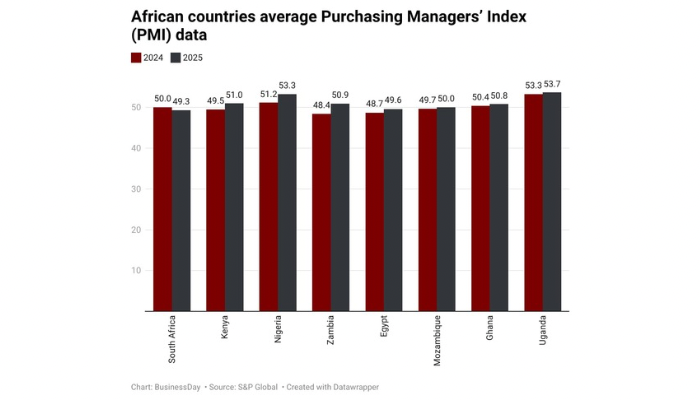
The nation’s manufacturing sector may not have totally come out of recession following the analysis of the first quarter unaudited financial statements which show mixed results for the 18 firms that featured in our analysis. This comes as the Central Bank of Nigeria (CBN) reported a rise in Manufacturing Purchasing Managers’ Index (PMI) for March 2018.
The companies in question are Okomu Oil, Livestock Feeds, Nigerian Breweries, Lafarge, Dangote Cement, Unilever, Cadbury, GSK, Fidson and Morison Industries. Others are BOC Gases, Beta Glass, Total Nigeria, Eterna, Forte Oil, Paints and Coasting, CAP and Premier Paints. The analysis focused on growth in their revenues, cost of sales and profit after tax (PAT). We also analysed their operational efficiency using cost of sales to revenue and profit margin.

For the first quarter ended March 31, 2018, collectively, the revenue made by the 18 manufacturing firms stood at N636.14 billion, representing 5.94 percent increase over N600.45 billion realised same period in 2017. The combined profit after tax rose by 11.9 percent from N83.87 billion in similar period in 2017 to N93.83 billion in March this year. However, their cost of sales equally trended upward by 3.48 percent from N383.67 billion in the first quarter of 2017 to N397.01 billion as at March this year.
While the combined revenue and PAT trended upward, the same cannot be said of these firms when we examined their individual performance. For instance, Okomu Oil and Livestock are players in the nation’s agric and agro-allied sector. For the period that ended in March 2018, the only similarity between the two firm is that they both reduced their cost of sales. Okomu Oil’s cost of sales fell by 48.17 percent to N655.18 million from N1.26 billion in corresponding period in 2017. But while Okomu Oil’s gross earnings and PAT rose by 24.52 percent and 13.16 percent, Livestock Feeds saw a decline in both metrics to the tune of 48.17 percent and 684.98 percent respectively. From N5.89 billion in Q1 2017, Okomu Oil’s revenue rose to N7.34 billion in the first quarter of 2018. Similarly, PAT rose to N3.47 billion in Q1 2018 as against N3.07 billion in Q1 2017. Livestock Feeds’ revenue declined to N1.62 billion from N3.12 billion during the reference period while it made a loss after tax of N102.93 million in March 2018 compared with a profit after tax of N17.6 million in same period last year.
An analyst has attributed the contrasting performance of these firms the business line each firms presently engages in.
“Okomu Oil is into the production of crude palm oil which is on high demand presently as local producers cannot meet the market demand. As a result of this, the company can afford to increase prices of its produces based on the market situation in order to maximise profit. On the contrary, Livestock Feeds is under cost pressures. Maize, which is their major input is very expensive in the market as well as the firm faces serious competition from big players such as Olam”, Fola Abimbola, research analyst at CSL Stockbrokers, said.
At 47 percent, Okomu Oil’s profit margin fell in the first quarter of 2018 when compared with 52 percent in similar period in 2017. The company was able to improve its efficiency during the period as the cost of sales to revenue fell to 9 percent at the end of Q1 2018 compared with 21 percent as at the end of the first quarter of 2017. For Livestock Feeds, at 95 percent cost of sales to revenue, the firm spent 95 percent of a dollar to generate a dollar revenue in the first quarter of 2018 compared with 88 percent in Q1 2017.

GSK and Fidson Healthcare posted modest growth across all metrics. GSK’s revenue was up 9.46 percent from N3.85 billion in Q1 2017 to N4.21 billion in Q1 in 2018. Profit after tax rose to N258.29 million as against a loss after tax of N8.26 million in Q1 2017. Profit margin improved from -0.2 percent in Q1 2017 to 6 percent in Q1 2018. In the same manner, cost of sales to revenue declined from 75 percent in Q1 2017 to 71 percent in Q1 2018.
Fidson’s gross earnings were up by 5.51 percent from N3.42 billion in Q1 2017 to N3.61 billion in Q1 2018. PAT rose to N202.80 million from N160.98 million, representing an increase of 25.98 percent during the period. Profit margin was up from 4.7 percent in Q1 2017 to 5.6 percent as at the end of March 2018. However, the firm spent 52 percent of its earning to generate a dollar revenue in the first quarter of 2018 compared with 48 percent in Q1 2017.
Total Nigeria saw a decline in gross revenue to the tune of 5.99 percent from N80.46 billion in Q1 2017 to N75.65 billion in same period 2018. On the contrary, Eterna and Forte Oil posted 4.56 percent and 20.63 percent increase in gross revenue for the period. From N51.96 billion in Q1 2017, Eterna’s gross earnings stood at N54.33 billion in Q1 2018. Forte Oil’s revenue rose to N39.81 billion from N33 billion during the period.
On the contrary, both Total and Eterna had their PAT decline for the period. As against N2.67 billion, Total’s PAT for Q1 2018 fell to N1.67 billion, and from N681.5 million in Q1 2017, Eterna Plc’s PAT fell to N510.82 million during the period. For Forte Oil, PAT rose to N2.96 billion in Q1 2018 from N1.88 billion in Q1 2017.
“Forte Oil is more diversified than Total and Eterna as it is into downstream and power generation businesses. As a downstream player, Total Nigeria plays in a segment of the industry where prices are fixed”, Kayode Tinuoye, research analyst at the United Capital, said.
“The company and its subsidiaries are primarily engaged in the marketing of petroleum products which is divided into fuels, production chemicals, lubricants, greases and power generation”, according to Forte Oil Plc in its Q1 2018 unaudited results when reporting its principal activities. Amperion Power Distribution Company Limited and Geregu Power Plc are its foothold in the Nigerian power sector.
“On the average, the results are decent particularly if you compare them with the low base in Q1 2017. We are going to see much of the same in the second quarter of the year and we expect their results to spike in the third quarter of the year. We base our assumption on the declining interest rates, cost reduction and decent export revenues”, Tinuoye added.
Paints and Coating, CAP and Premier Paints exhibited similar characteristics as others highlighted above. Paints and Coasting recorded a decline in sales to the tune of 23.35 percent; reduced cost of sales by 40.70 percent while PAT rose by 44.29 percent. On the other hand, its profit margin improved marginally from 1 percent to 2 percent during the period, efficiency improved as cost of sales to revenue declined from 64 percent in Q1 2017 to 50 percent in Q1 2018.
CAP revenue was up 13.32 percent from N1.73 billion to N1.96 billion during the period. Both cost of sales and PAT rose by 11.76 percent and 18.43 percent respectively. Similarly, profit margin improved marginally from 23 percent in Q1 2017 to 24 percent in Q1 2018, just as the cost of sales to revenue declined from 52 percent in Q1 2017 to 51 percent in Q1 2018.
Premier Paints posted 34.84 percent increase in gross revenue just as its cost of sales was up by 17.43 percent. Regardless, it ended the first quarter of 2018 in the red as loss after tax stood at N17.94 million compared to a loss after tax of N22.07 million in Q1 2017.
As at the close of business last week Friday, Okomu Oil’s share price had risen by 14 percent year to date; Fidson, 47.6 percent; Eterna, 62.6 percent; GSK, 11.1 percent, Beta Glass, 47.1, Unilever, 33.9 percent; CAP, 14 percent; Dangote Cement, 6.5 percent and Forte Oil 4.0 percent. Others either closed neutral or ended the period in the negative territory.
TELIAT SULE