From the moment our South African Airways flight touched down in Johannesburg, I felt the continent breathing differently.
The air was crisp, the light golden, and I knew, even before the wheels stopped rolling, that this week as an MTN-MIP Cohort 4 fellow would mark me forever.
We had been gently spoiled before we even left Nigeria. At Murtala Muhammed Airport, MTN opened the doors of its Prestige Lounge to us. Warm lighting, plates of jollof and spring rolls that disappeared too quickly, Wi-Fi that never stuttered, and staff who greeted us by name.
By the time we boarded, the usual travel tension had melted away. We were 22 Nigerian journalists carrying notebooks, cameras, and quiet expectations. South Africa was waiting to teach us something we did not yet know we needed to learn.

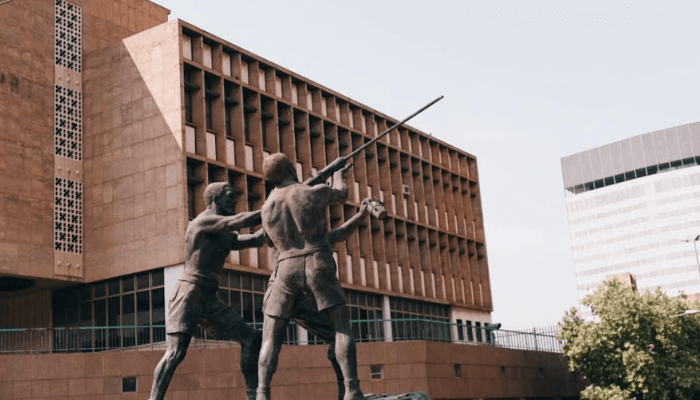
The first real lesson came the very next afternoon, and it came without words at first. Constitution Hill appeared suddenly, beautiful and brutal at the same time. The Constitutional Court stands there now, all glass and light, but behind it, the Old Fort Prison still keeps its shadows.
We walked the same corridors where Nelson Mandela was held in 1956, the only Black prisoner among white political detainees. The walls are thick, the cells tiny. You can almost hear the boots and the keys. Yet from that same ground rose the highest court in the land, the one that now guards the most progressive constitution on earth. Pain turned into protection.
That is the first whisper South Africa gave me: broken places can become the strongest foundations. But the whisper became a shout at two other stops that day.
We drove to Soweto, to Vilakazi Street, the only street in the world that has been home to two Nobel Peace Prize winners: Nelson Mandela and Desmond Tutu. Mandela House is smaller than I imagined. Four rooms. Bullet holes are still patched in the walls from the attempts on his life. A simple kitchen where Winnie cooked while the world hunted her husband.
Photographs of a young Mandela in sharp suits and of his children who grew up visiting their father in prison. There is a pair of his shoes by the door, worn soft, as if he has just stepped out and will be back any minute. I stood in the sitting room and felt time fold.

This is where the man who would free a nation once argued with his wife about school fees and electricity bills. Ordinary life inside extraordinary history. The house does not shout. It simply says: greatness begins at home, in the middle of struggle, with people who refuse to be small.
Then came the place that finally broke us open: the Apartheid Museum. You do not walk into the Apartheid Museum. You are pulled in. Your entry ticket is randomly stamped “White” or “Non-White”, and you must use separate gates, just for a moment, just long enough to taste the poison of separation. Inside, the air grows heavy.
There are 131 nooses hanging from the ceiling, one for every political prisoner executed under apartheid. Casspir armoured vehicles loom like sleeping monsters. Television screens play old footage of police dogs tearing into children, of Sharpeville bodies lying in the dust, and of Soweto school pupils marching for the right to learn in their own languages and being shot in the back. But the museum does not leave you in the darkness. It walks you forward, slowly, deliberately.
You see the secret newspapers printed on rice paper and swallowed if the police came. You see the tiny radios hidden in matchboxes that carried the voice of freedom across townships. You read the letters smuggled out of Robben Island, written in code, in hope.
You stand in front of the Truth and Reconciliation Commission testimonies where victims looked their torturers in the eye and chose forgiveness over revenge.
You watch the lines of people, kilometres long, waiting in 1994 to vote for the first time in their lives, some of them seventy or eighty years old, carrying walking sticks and wearing their Sunday best.
I watched an old woman on the screen, tears running down her cheeks as she placed her ballot paper in the box. She said, “I feel like a human being today.”
That sentence cracked something inside me. I thought of elections in my own country where violence still steals votes, where young people stay home because they believe nothing will change. I thought of how easy it is to grow tired. South Africa was tired too. They were exhausted, angry, and bleeding.
Yet they found a way to walk out of the night together. Not perfectly. Not without new wounds. But together. They did it through a sacrifice most of us can barely imagine. Students gave their lives in 1976 so that their younger brothers and sisters could learn in their mother tongue. Mothers marched to police stations demanding to see their disappeared children.
Lawyers risked everything to defend the undefendable. Ordinary workers stayed away from factories until the cost of oppression became too high for the oppressor. Trade unions, churches, sports boycotts, underground networks, songs that carried messages the police could not decode – everything became a weapon of liberation. And when victory finally came, they chose the harder road. Instead of revenge, they built the Truth and Reconciliation Commission.
Instead of tearing down, they wrote a constitution that protects even the people who once tried to destroy them. They turned the prison on Robben Island into a garden where flowers now grow between the stones that Mandela broke for eighteen years. That is the deepest lesson the museum pressed into my heart: freedom is not the end of the story. Freedom is the beginning of the hardest part: choosing every day not to become what you are.
Every African country needs to sit with this truth. Nigeria, my own noisy, beautiful, complicated Nigeria, needs to sit with it longest. We carry our own wounds: Biafra, June 12, EndSARS, and the daily small apathies that kill hope. We have our own Mandelas who paid prices we now forget too easily. We have townships of the spirit where young people feel the system was built to keep them out.
But South Africa is proof that the story does not have to end in bitterness. A nation can choose, after everything, to build instead of burn.
It can choose truth over silence, reconciliation over victory dances on graves. It can choose to make the children of its former enemies feel safe enough to dream. I left the museum quietly. We all did. No one posted Instagram stories for a long time. The days that followed were bright and busy. The University of Johannesburg welcomed us with open arms and sharp minds. Panels on media and diplomacy reminded us that storytelling is now part of statecraft.
The South African Institute of International Affairs spoke plainly about Nigeria-South Africa relations and how we waste our brotherhood on small quarrels while the world moves ahead. We laughed, we argued, and we took notes until our hands hurt.
Yet every conversation circled back to the same root: if the people do not know their own worth, no amount of technology or diplomacy will save them. And the museum had just spent hours proving that worth is not given; it is taken, defended, and then generously shared.
I recorded a short voice note to myself: “When we tell African stories from now on, let them carry this weight and this light. Let them remember that liberation is never finished. Let them remind every leader that power is borrowed from the people and every journalist that silence in the face of wrong is betrayal.”
South Africa has not fixed everything. Xenophobia still raises its ugly head. Inequality is a daily insult. But they have shown that a people can rise from actual chains and still choose to build bridges instead of walls. That is the gift they pressed into my hands as we prepared to come back to Nigeria. I carried it home carefully, the way you carry fire.
When our plane lifted, 22 Nigerian journalists were quieter than when we arrived. Not because we are sad, but because we now carry something heavy and beautiful: the living proof that Africa can heal itself when it decides, together, that tomorrow must be better than yesterday.
Thank you, MTN, for opening eyes. Thank you, South Africa, for the honest mirror. The story continues, and this time, we know exactly how to write the next chapter.